
News room



Itoki and Matsuo Research Institute have used AI to analyze the behavioral data of 854 individuals and built a "data-driven productivity estimation model."
By exploring the causal relationships between 70 types of behavioral data and "physical and mental condition" and "interpersonal relationships within the company," we identified the bottlenecks in "productivity improvement," which proved to be a challenging area to address.
ITOKI CORPORATION (Head office: Chuo-ku, Tokyo; President and CEO: Koji Minato; hereinafter referred to as "the Company") announces the latest results of its joint research on productivity with Matsuo Research Institute Co., Ltd. (Head office: Bunkyo-ku, Tokyo; President and CEO: Nobuyuki Kawakami; hereinafter referred to as "Matsuo Research Institute").
This study utilized AI to extract 70 types of behavioral data—including meetings, emails/chat, and office movement—from the daily work of 854 employees using sensors, and constructed a "data-driven productivity estimation model" to explore the causal relationships of productivity improvement. Furthermore, the latest analysis results, which demonstrate the model's usefulness, confirmed that the "number" of meetings, rather than their "length," had a greater impact on the mental state of employees the following day. Conversely, on days when employees were able to concentrate on work for 60 minutes or more without interruptions from meetings, 88% of employees across all job categories reported improved mental state the following day. Additionally, the study revealed new insights for improving work styles, such as the finding that the "amount of received" emails/chat messages, rather than the "amount of sent" messages, had a greater impact on interpersonal relationships within the organization.
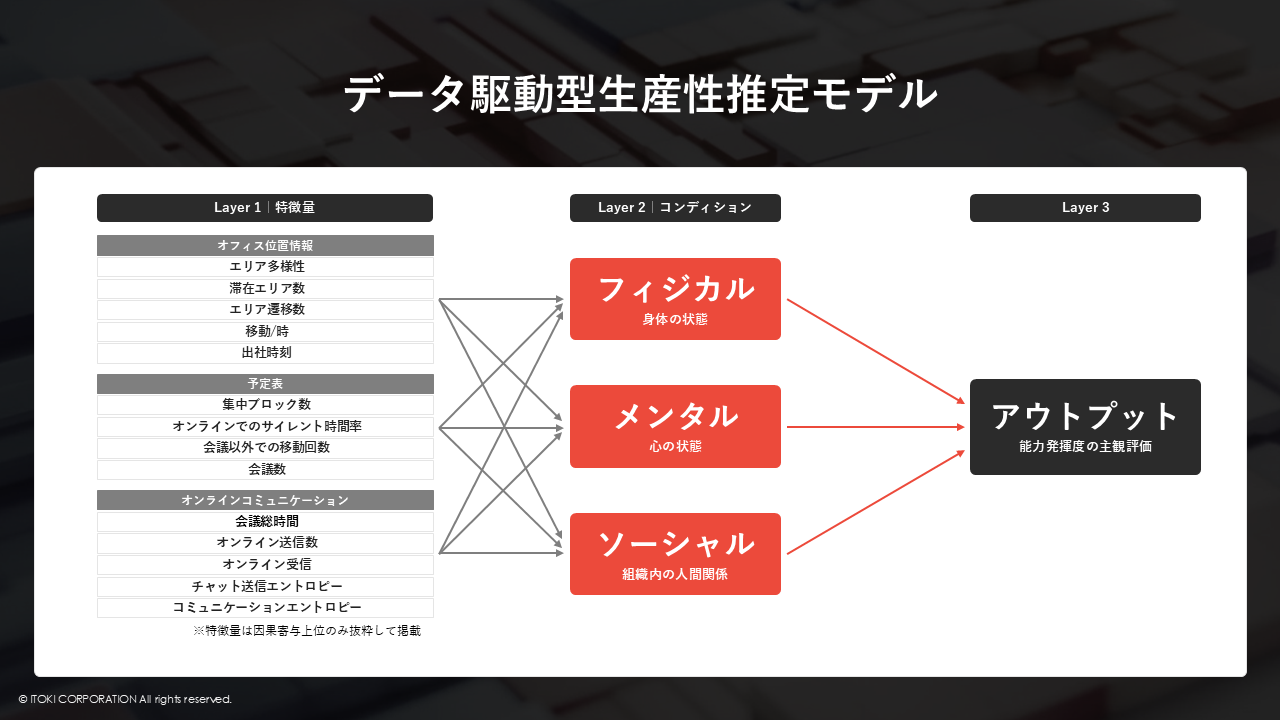
Data-driven productivity estimation model (simplified display)
Background: While it's understood that productivity is low, it's unclear what needs to be changed.
While investment in human capital is increasing, a major challenge for companies is how to visualize the return on that investment and how to measure and improve employee productivity. The metrics for work performance, such as production volume or sales figures, vary depending on the company and job type. Furthermore, productivity is influenced by many factors, including personnel systems, work tools, physical and mental well-being, and interpersonal relationships within the organization.
Up until now, our company has primarily focused on surveys targeting office workers to understand the state of employees and the office environment. However, while we could grasp whether the situation was good or bad, it was difficult to identify the causal relationships that led to improvements. Furthermore, recent research has shown the importance of capturing intermediate indicators such as enthusiasm, concentration, and communication, rather than viewing productivity solely as outputs such as sales and production volume, and inputs such as working hours and work tools.
Therefore, in 2025, our company and Matsuo Research Institute began a joint research project on productivity that utilizes daily behavioral data of office workers, using their mental and physical state and interpersonal relationships within the organization as intermediate indicators to clarify their causal relationships. Rather than relying on subjective surveys, we are exploring causal relationships that affect productivity by mainly using objective data such as meetings, emails, chats, calendars, and office activity data. Our aim is to clarify "what productivity is" and "what needs to be changed to improve it."
Implementation details and novelty: AI was used to analyze 70 types of "behavioral data," including meetings, emails, and travel, and differences based on time series and job type were also examined.
In this study, we collected data from 854 employees working at our head office from December 1st to December 31st, 2025. From this data, we extracted 70 types of behavioral data that represent daily work style factors, such as the number of times employees moved around the office, the duration and number of meetings, and the frequency of emails and chats.

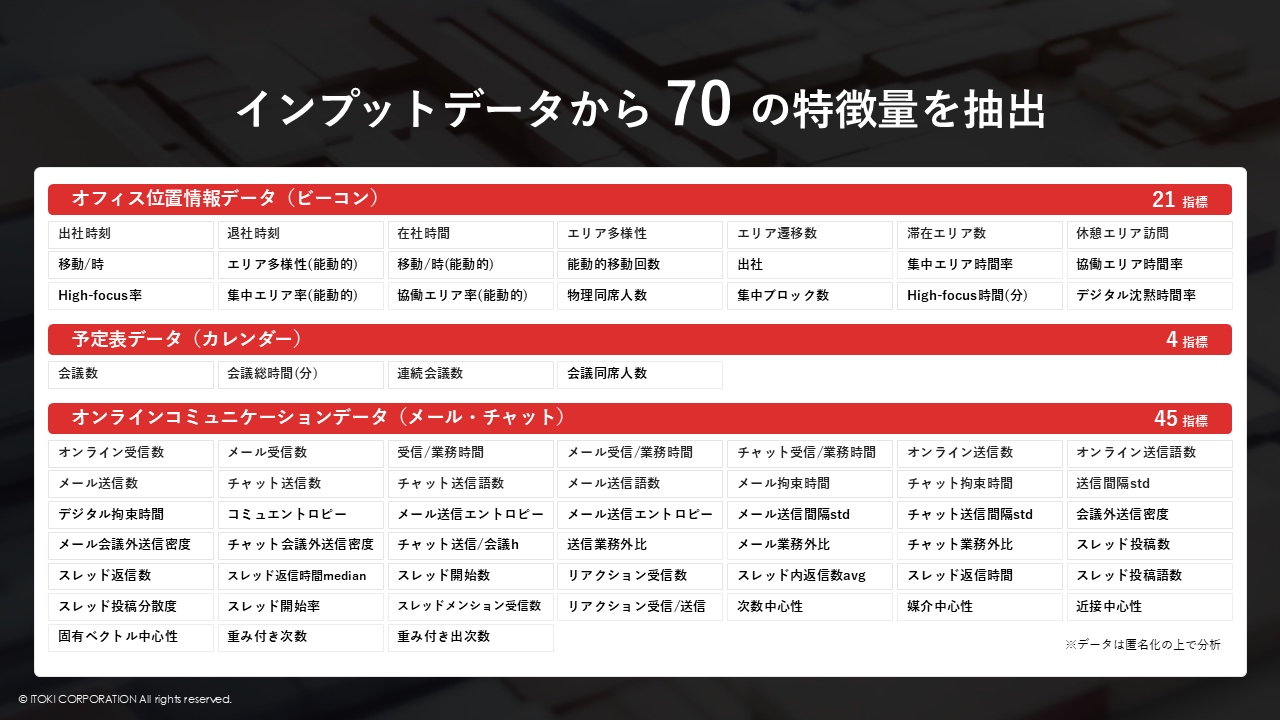
The analysis included 70 types of behavioral data (21 location data, 4 schedule data, and 45 online communication data).
Furthermore, we conducted a causal investigation into the impact of these "70 types of behavioral data" on "conditions" such as physical and mental health and interpersonal relationships within the company, and on "output" (in this case, the level of performance of each employee). We captured the behavioral data for the day and the state of the day and the following day in a time series, and compared them by dividing them into three types of job roles: "design, development, and planning," "sales and service," and "management," to examine the differences between job roles.
Based on these analysis results, we constructed a "data-driven productivity estimation model" that enables the identification of behavioral factors influencing conditions and output. In this study, we analyzed large-scale behavioral data from 854 individuals and identified the causal relationship between work style and productivity. A major feature of this study is that, unlike conventional productivity analyses which often only grasp the actual situation, it clarifies the causal relationship based on data.

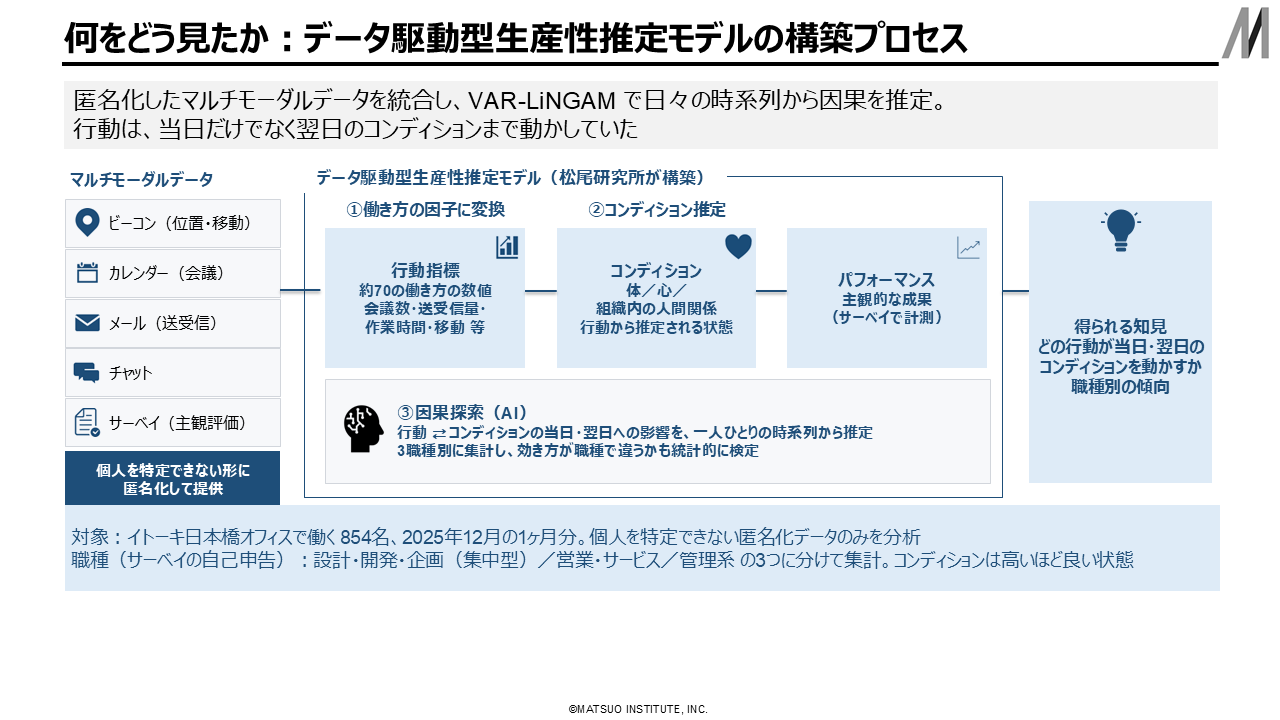
Analysis method
The core of this model is the time-series causal exploration method "VAR-LiNGAM (*)".
We applied this method to the daily behavioral data of each employee and built a model by aggregating it by job type. Traditional correlation analysis could only reveal simultaneous relationships, such as "I feel unwell on days with many meetings," but it couldn't determine whether "I feel unwell because of many meetings, or whether I have more meetings because I feel unwell (low productivity)," nor could it identify the impact on the following day. This model estimates the direction and time difference of "today's actions → state the next day" from each employee's daily data, and by overlaying it by job type, it extracts only the relationships that appear in the same direction for many employees. This makes it possible to judge "effective behaviors" and "ineffective behaviors" using the same criteria.
*VAR-LiNGAM: An extension of the "LiNGAM" method, which estimates the direction of causality based on the bias in the distribution of data, to time series data (Hyvärinen, Zhang, Shimizu & Hoyer, 2010, Journal of Machine Learning Research).
Analysis results
Analysis Result ①: The "number" of meetings, rather than their "length," has a greater impact on the following day.
The latest analysis, demonstrating the usefulness of this model, confirmed a common factor across all three job categories—"Design/Development/Planning," "Sales/Service," and "Management"—the impact of the number of meetings on mental condition the following day. On days with a high number of meetings, a decline in mental condition was observed the following day. The same trend was seen across all three job categories, and this analysis showed that the number of meetings had a stronger impact than the total meeting time.
When reviewing meetings, it's important to consider ways of working that don't require meetings in the first place, and to reduce the number of meetings from that perspective.
Analysis Result ②: On days when they were able to concentrate for 60 minutes or more, 88% of all job types reported improved condition the following day.
On the other hand, the opposite was observed on days when employees were able to work uninterrupted for 60 minutes or more without interruptions from meetings. 88% of employees across all job categories—design, development, planning, sales, service, and management—reported an improvement in their mental state the following day. This result suggests that not only shortening meetings, but also ensuring uninterrupted work time is crucial for improving employees' well-being.
Analysis Result ③: Email and chat are more influenced by "receiving volume" than "sending volume".
In digital communication, different impacts were observed between sending and receiving messages. In particular, among those in sales and service roles, a decline in multiple health conditions, including interpersonal relationships within the organization and physical condition, was observed on days when there was a high volume of email and chat messages received.
On the other hand, proactive online communication has had an impact on improving interpersonal relationships within the organization. Email and chat are not simply burdensome due to their high usage; rather, the impact on employees differs depending on whether they are "proactively communicating" or "continuously receiving information."
Analysis Result ④: Some work styles may seem related at first glance, but they do not have a uniform impact.
In this model, we also captured the following behaviors, which do not show a consistent causal relationship with "output" across the entire organization.
- Length of time spent in the office
- Number of times the rest area is used
- Speed of response to emails and chats
- Length of time spent connected to the digital world
This shows that we cannot simply say that "being in the office for long hours means good/bad condition" or "the faster you respond, the more productive you are." This result highlights the need to capture data on which actions influence which conditions, not just the amount of time worked or activity level.

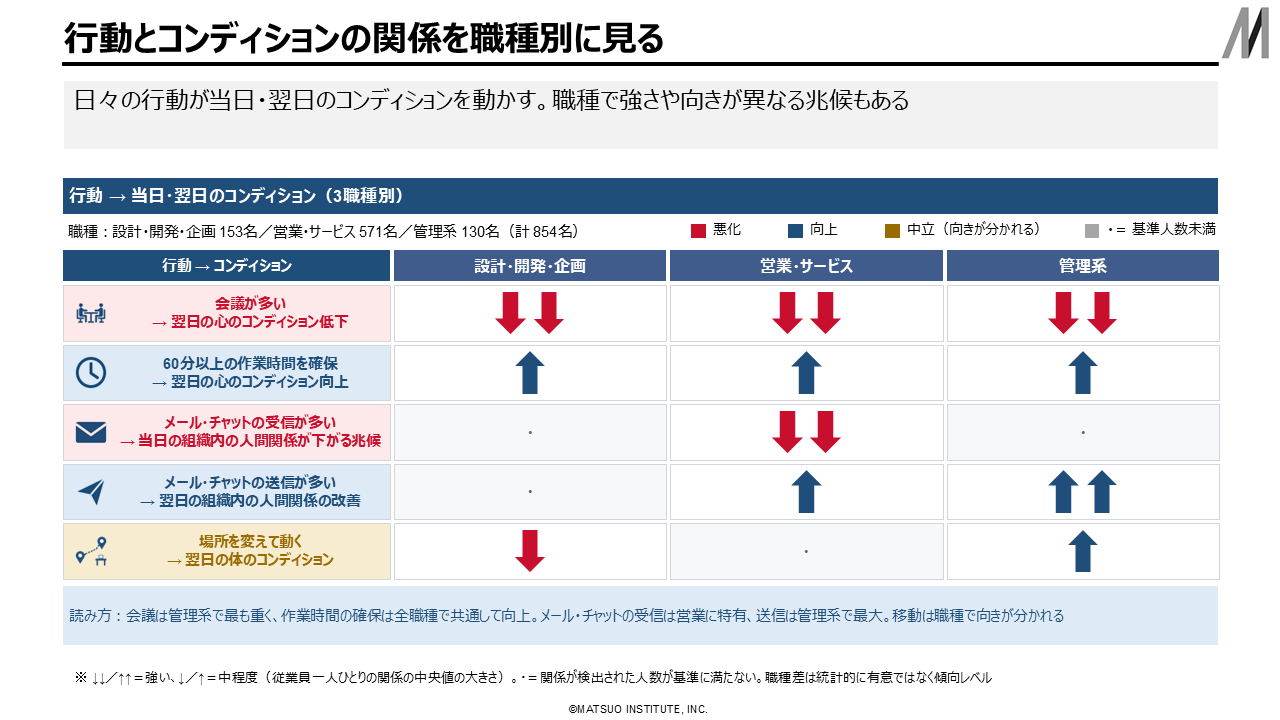
By constructing a causal model, we can consider specific measures that will lead to increased productivity.
Until now, surveys answered by the employees themselves have been an important means of understanding the working conditions. However, answering these surveys involves a certain burden, and there are limitations in ensuring the objectivity and continuity of the analysis.
This time, by constructing a "data-driven productivity estimation model" that explores causality by combining survey results with objective behavioral data, we have opened up the possibility of continuously capturing productivity-related conditions and their factors by utilizing only daily objective behavioral data in the future.
This has created a foundation for identifying what is lowering or raising the performance level for each organization and job type, rather than implementing a uniform policy such as "reducing meetings," and for developing concrete improvement measures such as reducing the number of meetings or allocating sufficient focused time.
About the future
Going forward, we will expand the model developed in this research to different job types, locations, and companies, improving its accuracy and applicability to capture the causal factors influencing productivity for each customer. Furthermore, we will combine this with our accumulated expertise in office design and operation to propose space design and operational measures tailored to each company's work style goals and characteristics.
Our company is working to not only understand the actual state of productivity through causal exploration using data and AI, but also to unravel the underlying behavioral and environmental factors. We aim to scientifically clarify "why that state occurs" and "which behaviors should be changed," thereby achieving productivity improvements while considering the well-being of employees.
Joint research overview
| Research name | Research on Productivity Evaluation Using Multimodal Data in Offices |
|---|---|
| Researcher | ITOKI CORPORATION, Matsuo Research Institute Co., Ltd. |
| Research assignment | Itoki: Data and conventional model provision Matsuo Research Institute: Data Analysis and New Model Construction |
| Subject of analysis | 854 employees working at the head office |
| Analysis period | December 1-31, 2025 |
| data | Office activity data, calendar, email, chat, surveys, etc. |
| Analysis items | 70 types including meetings, focused work time, travel/stay locations, and online communication. |
| Analysis method | Time-series causal exploration (VAR-LiNGAM), occupational analysis, etc. |
| Research purpose |
|
| remarks |
|
Related Information
- Itoki and Matsuo Research Institute begin joint research on productivity, visualizing productivity with AI.
https://www.itoki.jp/company/news/2025/0729_ai/
- Itoki and Matsuo Research Institute analyze the relationship between the purpose of movement and productivity in ABW offices by job type.
https://www.itoki.jp/company/news/2026/0701_jsai/
ITOKI OFFICE AI AGENTS
Itoki announces three AI agent groups, "ITOKI OFFICE AI AGENTS," marking a shift to the industry's first "AI management model."
https://www.itoki.jp/company/news/2026/0220_ai/
ITOKI STORY
WORK-Style more comfortable and more personal. An AI-driven, nurturing office.
https://www.itoki.jp/company/itokistory/column/2026021.html
About Itoki's Workplace Business
ITOKI CORPORATION was founded in 1890. With the mission statement of "We Design Tomorrow. We Design WORK-Style. the company supports the creation of a variety of spaces, environments, and places, leveraging its strengths in "AI x Design based on people," including the manufacture and sale of office furniture, office space design, “Space," “Environment," and “Place" consulting, and office data analysis services, as well as furniture for working from home and studying at home, and equipment for public facilities and logistics facilities.
As hybrid work becomes more common and places and ways of working become more diverse, we are developing spatial digital transformation to enhance productivity and creativity, as well as consulting services to support optimal office operations. We are also proactively collaborating with external designers and partner companies to propose new work styles and workplaces for the future.
About Matsuo Research Institute Co., Ltd.
Matsuo Research Institute Co., Ltd. is a research institute established with the aim of creating and significantly developing an "ecosystem" that generates innovation centered on universities, in collaboration with the Matsuo-Iwasawa Laboratory at the Graduate School of Engineering, The University of Tokyo. Matsuo Research Institute develops and implements research results and technologies produced in academia, aiming to disseminate them widely to society and contribute to improving Japan's industrial competitiveness.
Press personnel
Contact information
ITOKI CORPORATION
Corporate Communications Division, Public Relations
TEL:03-6910-3910
- The information posted is current at the time of publication. Please note that the information may differ from the latest information.