
News room



Itoki and Matsuo Research Institute analyze the relationship between the purpose of movement and productivity in ABW offices by job type.
At the Japanese Society for Artificial Intelligence, we presented findings suggesting that proactive location selection, rather than passive movement associated with meetings, could contribute to increased productivity.
ITOKI CORPORATION (Headquarters: Chuo-ku, Tokyo; President and CEO: Koji Minato; hereinafter referred to as "the Company"), in collaboration with Matsuo Research Institute Co., Ltd. (Headquarters: Bunkyo-ku, Tokyo; President and CEO: Nobuyuki Kawakami; hereinafter referred to as "Matsuo Research Institute"), presented research results analyzing the relationship between employee movement and loitering behavior and productivity-related indicators in Activity-Based Working (ABW) offices, broken down by job type, at the 2026 Annual Conference of the Japanese Society for Artificial Intelligence (JSAI 2026).
This study analyzed the correlation between the quality of movement and productivity based on location data and meeting reservation data from 945 employees working at our head office during the month of December 2025. The results suggest that distinguishing between passive movement associated with meetings and proactive location selection based on work tasks may be important in the operational design of Activity-Based Working (ABW) offices.
Background of the collaborative research
In recent years, against the backdrop of a declining workforce and increased competition for talent, companies are increasingly required to improve productivity and employee engagement. Furthermore, with the establishment of hybrid work and the diversification of workplaces and working styles, "what increases productivity" varies depending on the company, organization, and job type, making it difficult to grasp the overall picture.
Furthermore, advancements in office sensing and analysis technologies have made it possible to acquire and analyze data related to the work environment from multiple perspectives, including office layout data, in-office behavior data, and organizational condition data. On the other hand, how to interpret this data in relation to productivity and organizational performance, and how to use this to improve office operations, has become a new challenge for companies.
To address these challenges, we began joint research in 2025, aiming to gain a more objective understanding of the relationship between the work environment and productivity by combining our company's expertise in office design and work style data with Matsuo Research Institute's expertise in AI and data analysis.
This joint research project focuses on "Research on Productivity Evaluation Using Multimodal Data in the Office." Its objectives are to "Defining productivity and constructing behavioral and environmental models that contribute to its improvement" and "Establishing objective methods for measuring and verifying productivity."
As a company that designs and builds office spaces, we believe that an office is not merely a place to work, but a place that enhances the productivity and creativity of employees and the overall performance of the organization. Currently, we are strengthening our efforts to continuously improve the working environment and evolve our office "operations," utilizing the insights gained from this research.
Objectives of the ABW Office Research
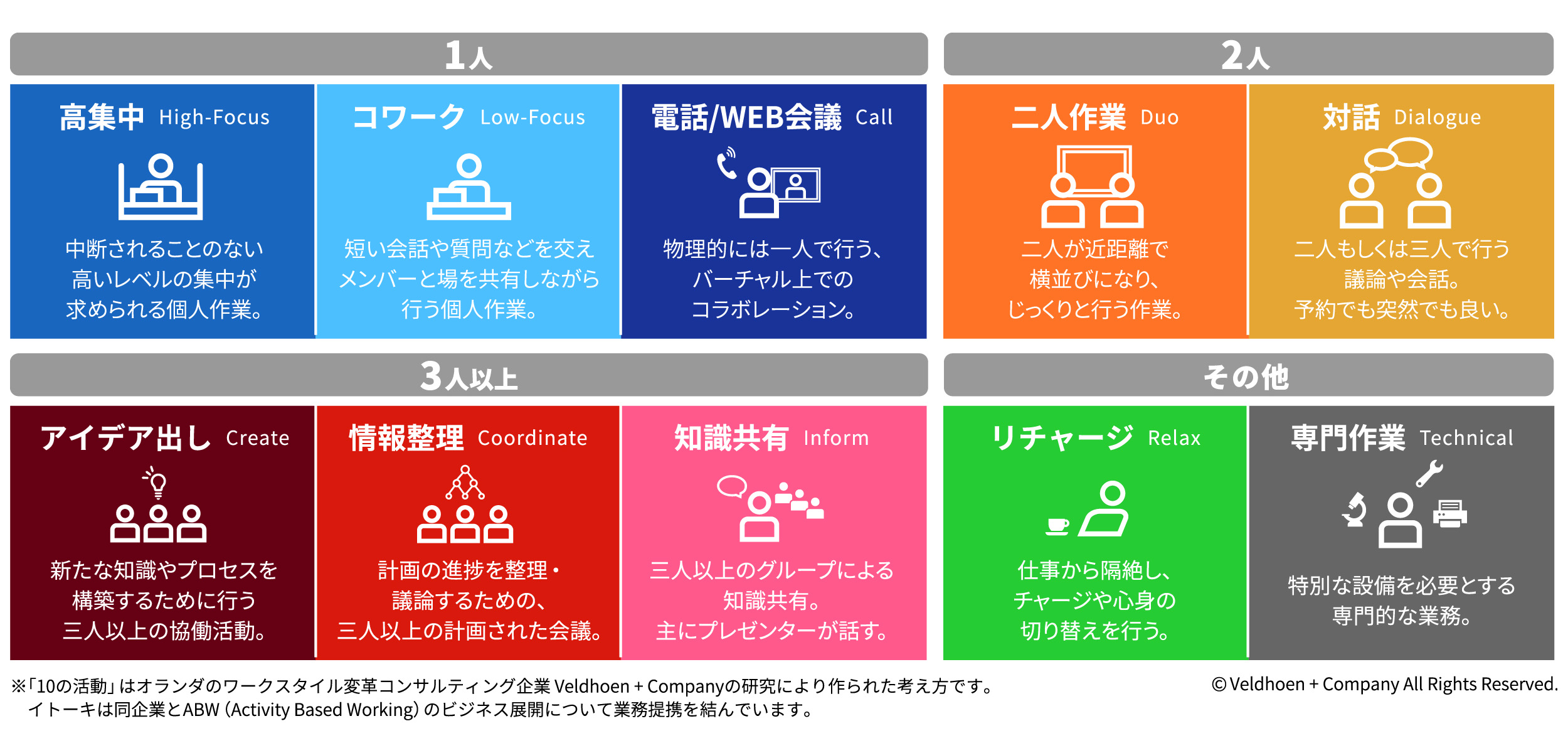
Details of ABW10 activities
Activity-Based Working (ABW), which our company began fully implementing and proposing in 2019, is an office management approach that allows employees to choose their workspace according to the nature of their work, such as "high concentration," "dialogue," and "information organization." The ability to choose a location based on purpose, rather than being tied to assigned seats, leads to flexible work styles and effective use of spatial resources. On the other hand, frequent movement and interruptions may be burdensome depending on the nature of the work.
Previous research on Activity-Based Working (ABW) has primarily focused on satisfaction levels before and after implementation, as well as subjective productivity assessments. Studies linking daily office location data and meeting reservation data with performance indicators, and comparing these across different job functions, have been limited.
This study aims to provide insights into designing office operations tailored to job types and work characteristics in the implementation of Activity-Based Working (ABW) and hot desking.
Overview of the ABW Office Research
In this study, we used BLE beacons to collect movement and dwell time data within our head office for 945 employees working there for one month in December 2025. During the experiment, employees performed their work as usual, and the collected data was anonymized to calculate behavioral indicators for each employee.
The four main behavioral indicators used in the analysis are as follows:
• Number of moves per day
distance traveled
• Number of active movements
- Uneven distribution of accommodation locations
Furthermore, productivity-related indicators are used to quantitatively evaluate workplace productivity by calculating an individual's social, mental, and physical condition based on business, work, and lifestyle information obtained from subjective evaluations of individuals through questionnaires.
We categorized job roles into three types: "Design, Development, and Planning (Centralized)," "Sales and Service (Non-routine)," and "Management (Routine Tasks)." We then analyzed the relationship between behavioral indicators and productivity-related indicators for each job role.
Furthermore, we defined "proactive travel" as travel that does not overlap with meeting times, utilizing meeting reservation data from the schedule. This allows us to distinguish between travel associated with scheduled events such as meetings and travel where the location is chosen according to one's own work, and attempts to evaluate the "proactive location selection" inherent in Activity-Based Working (ABW).
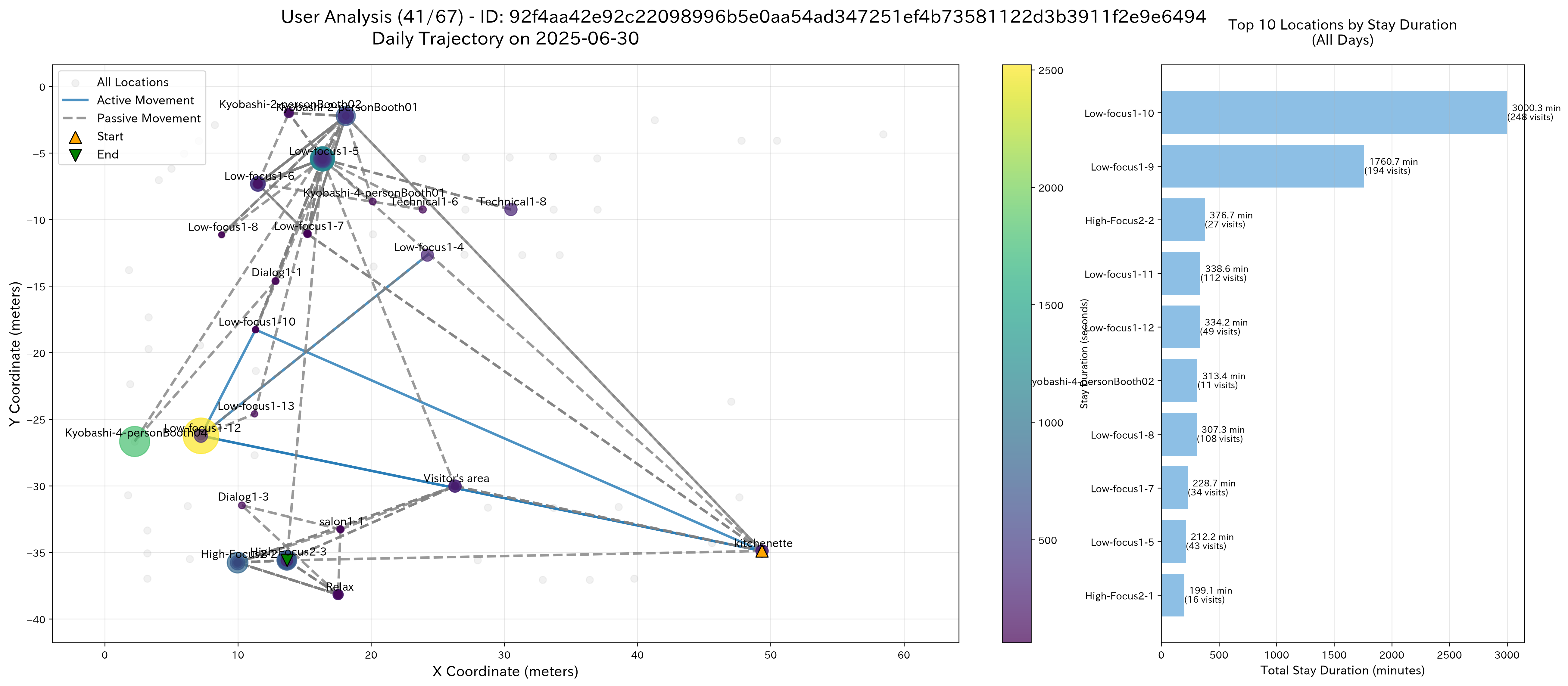
An example of a day's worth of location data for an employee. The left is a map showing places and movements, and the right is a graph of time spent in each location.
Results of the ABW Office Study
Frequent movement of administrative staff reduces productivity.
The analysis revealed a negative correlation between the number of travel trips during working hours and productivity-related indicators in management (routine tasks). On the other hand, no clear correlation was found in design, development, and planning (centralized) and sales and service (non-routine).
This suggests that in management tasks, travel can interrupt work and create a burden to regain focus, potentially impacting productivity.
- The longer the distance people have to travel to the office, the higher their productivity.
A comparison of four groups based on travel frequency and distance showed that the long-distance travel group had higher productivity-related indicators than the short-distance travel group. Long-distance travel may reflect collaboration with different departments and the volume of activity. This suggests that in environments with large offices, travel distance can serve as a proxy indicator of interdepartmental collaboration.
• Proactive movement increases productivity
Analysis of travel that did not overlap with meeting times, defined as "active travel," revealed a positive correlation with productivity-related indicators in sales/service (non-routine) and management (routine tasks).
While a negative correlation was observed for overall movement, a positive correlation was found for active movement. This suggests that passive movement and interruptions associated with scheduled events such as meetings may be a major factor negatively impacting productivity.
Proactive behavior in the office is crucial for improving productivity.
On the other hand, regarding "location bias," which indicates the degree to which employees spend time in specific locations, no clear correlation was found with productivity-related indicators in any job category. This result suggests that in operating an ABW office, it is more important to focus on "how employees move," that is, the frequency and distance of movement and their level of proactivity, rather than "where they are concentrated."
- Uniform travel and attendance at the office may have negative impacts.
These results indicate that in the operation of ABW and hot desking, it is important to design operations that encourage proactive location selection according to the task, while minimizing passive movement and interruptions associated with meetings, rather than uniformly "encouraging movement" or "encouraging employees to come to the office."
For general affairs and facilities management departments, this data provides insights for reviewing not only seating capacity and attendance rates, but also meeting room layout and operation, traffic flow, interdepartmental collaboration, and zoning based on different work styles.
Towards future collaborative research
Our company is working to combine various data from within the office to conduct a multifaceted analysis of the relationship between the work environment, work styles, and employee productivity. An office is not something that is "built and then forgotten"; by continuously improving it based on actual usage data, we can identify challenges in the work environment and use that to enhance work styles.
Going forward, we will develop the findings of this research into insights for the entire collaborative research project, and expand the analysis to include factors such as daily work performance, changes in conditions, the volume of meetings, work content, and organizational state.
Furthermore, within the Office 3.0 domain that we are promoting, we will connect with office data analysis services such as "Data Trekking" and "ITOKI OFFICE AI AGENTS" to develop it as a research platform for automated improvement and recommendations of office operations. We have already filed patent applications for the analysis system and analysis programs of this research, and have begun making proposals that leverage the knowledge gained from joint research, promoting the creation of workplaces that contribute to companies' human capital management and effectiveness verification of office investments.
Announcement Summary
| Presentation Title | Beacon behavior indicators, including active movement, and productivity analysis by occupation in ABW offices |
|---|---|
| English title | Occupational Differences in the Association Between Beacon-Derived Mobility Metrics, Including Active Mobility, and Productivity in an ABW Office |
| Presentation at the academic conference | The 2026 Annual Conference of the Japanese Society for Artificial Intelligence (JSAI 2026) |
| Announcement date | Monday, June 8, 2026 |
| session | 1F5-OS-10c-02 |
| Presenter | Matsuo Research Institute Co., Ltd. (Wang Chi-jing, Onishi Nao), ITOKI CORPORATION (Mitsui Rinko, Chiba Naoki, Ishiguro Rin) |
For your reference
• Location information service "Workers Trail"
https://www.itoki.jp/special/data-trekking/workers-trail/index.html
• Organizational survey service "Condition Lens"
https://www.itoki.jp/special/data-trekking/condition-lens/index.html
- Itoki and Matsuo Research Institute begin joint research on productivity, visualizing productivity with AI.
https://www.itoki.jp/company/news/2025/0729_ai/
remarks
- This study analyzes interpersonal differences and does not directly demonstrate causality. Further verification will be conducted in the future, including causal inference through intervention experiments and analysis considering changes in productivity indicators during the experimental period.
- After opting in, collected personal information is encrypted and stored for security purposes. Furthermore, during analysis, all data is converted to a unique pseudonym ID, ensuring that individuals cannot be identified.
About Itoki's Workplace Business
ITOKI CORPORATION was founded in 1890. With the mission statement of "We Design Tomorrow. We Design WORK-Style. the company supports the creation of a variety of spaces, environments, and places, leveraging its strengths in "AI x Design based on people," including the manufacture and sale of office furniture, office space design, “Space," “Environment," and “Place" consulting, and office data analysis services, as well as furniture for working from home and studying at home, and equipment for public facilities and logistics facilities.
As hybrid work becomes more common and places and ways of working become more diverse, we are developing spatial digital transformation to enhance productivity and creativity, as well as consulting services to support optimal office operations. We are also proactively collaborating with external designers and partner companies to propose new work styles and workplaces for the future.
Press personnel
Contact information
ITOKI CORPORATION
Corporate Communications Division, Public Relations
TEL:03-6910-3910
- The information posted is current at the time of publication. Please note that the information may differ from the latest information.