
News room



Itoki renovates its head office to achieve results despite a 1.5-fold increase in employee numbers and a 35% reduction in space per person.
Reconstructing a limited space with data, AI, and design to create a space that seamlessly connects solo work and team collaboration.
ITOKI CORPORATION (Headquarters: Chuo-ku, Tokyo; President and CEO: Koji Minato) has renovated approximately 2,700 square meters on the 12th floor of its headquarters working showroom, "ITOKI DESIGN HOUSE TOKYO," which has a total area of approximately 7,200 square meters, for the first time in four years. Based on data analysis of performance and location information, the renovation adopted the concept of "maximizing human capital and evolving 'team management' to lead to further results," and transformed the space into one where individuals can seamlessly move between solo work and team co-work.
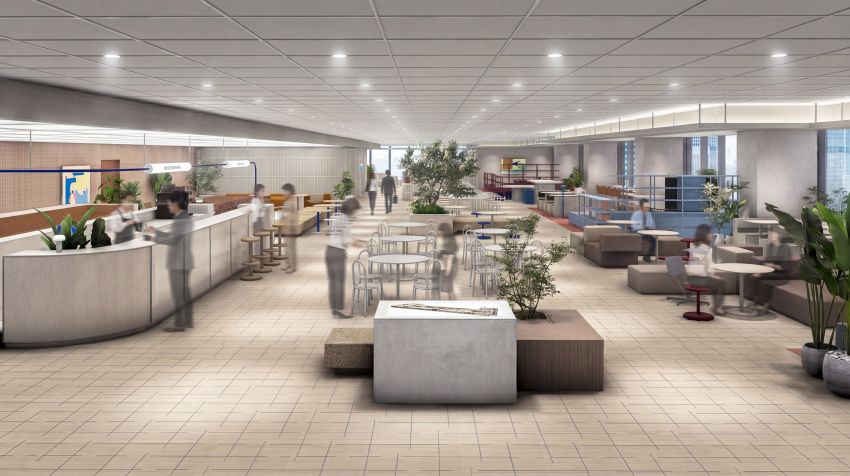
View of the entire office from the Open Work Area
Background: We are entering an era where offices that deliver results are required, even in limited space.
A work style that assumes employees are coming to the office is once again becoming widespread. In the "Office workers Awareness Survey 2025" conducted by our Central Research Institute targeting 5,296 office workers nationwide, 67.5% responded that they "do not currently work work remotely" regarding their work style.
On the other hand, office demand remains strong, particularly in central Tokyo, with vacancy rates declining and rents rising. For companies, expanding or relocating offices quickly is not easy, even if the number of employees or working styles change.
Furthermore, with growing interest in human capital management, offices are no longer merely a cost, but a management investment that supports employee performance, engagement, and productivity. With the expansion of human capital disclosure, it has become crucial to visualize the effects of these investments and explain their relationship to business results.
Even with approximately 1.5 times the number of employees and a 35% reduction in area per person, the employee experience has improved.
Between 2021 and 2026, the number of employees at our head office increased approximately 1.5 times, from 850 to 1,300. The area per person decreased by approximately 35%, from 8.5 square meters to 5.5 square meters, while the attendance rate increased from 40% to 70%.
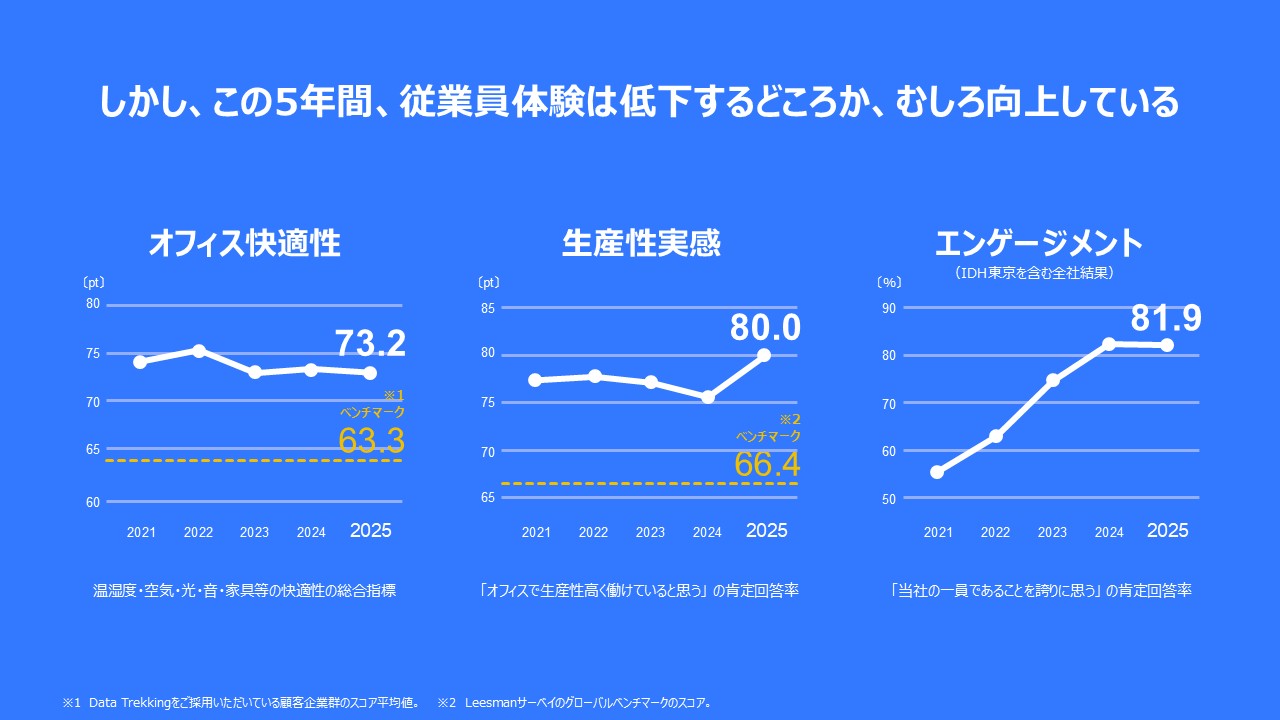
On the other hand, the employee experience has improved. Office comfort is projected to be 73.2 points in 2025, exceeding the benchmark of 63.3 points. Perceived productivity is 80.0 points, significantly exceeding the benchmark of 66.4 points. Employee engagement has also improved from 56.2% in 2021 to 81.9% in 2025. Return on Equity (ROE) has also improved from 2.6% in 2021 to 17.7% in 2025.
With increasing staffing levels and higher office attendance rates leading to cramped office spaces, how can we create a work environment that enhances the employee experience and supports business growth? Our company addresses this challenge by emphasizing the office design process based on office data analysis.
Identifying spaces that contribute to results through "performance level × location information"
In this renewal, we used the office data analysis service "Data Trekking" to analyze the location data of employees who demonstrated high or significantly improved performance over the past year, using office layout data. As a result, in 2021, the rate of performance improvement was high among users of solo work environments such as high-concentration desks, indicating autonomous individual work styles. However, in 2025, the rate of performance improvement was high among users of open areas and collaboration spaces, revealing that autonomous individuals are further improving their productivity through collaboration.
Furthermore, those who improved their performance by 5 points or more since the previous survey tended to spend longer periods in spaces that facilitated interaction with others, building relationships, and collaborating. Based on these results, we believe that in a business environment where higher goals and more advanced tasks are required, it is becoming increasingly difficult to perform effectively by working alone in isolation.
In particular, areas called "team coworking," where teams share time and space, have been confirmed to be effective in improving performance. Departments that frequently utilize team coworking achieved a performance score of 69.5 points, exceeding the 65.8 points for all company employees.
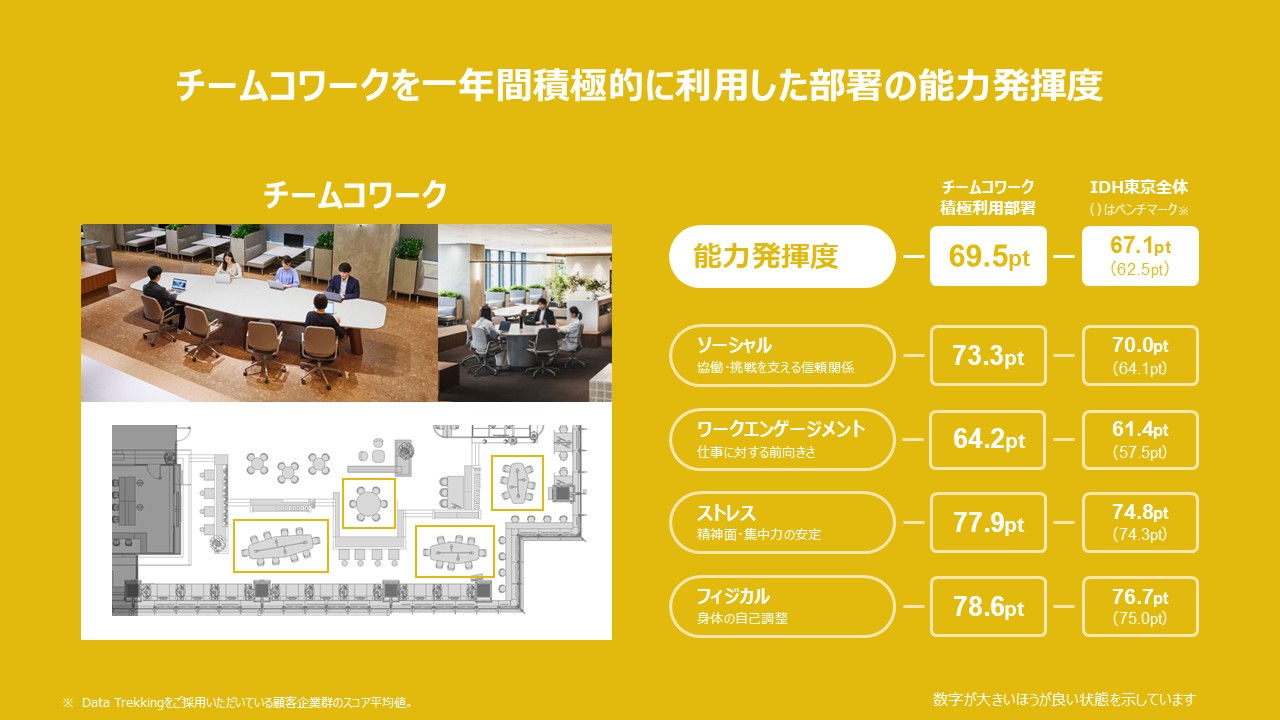
A space where you can move between solo work and team co-working.
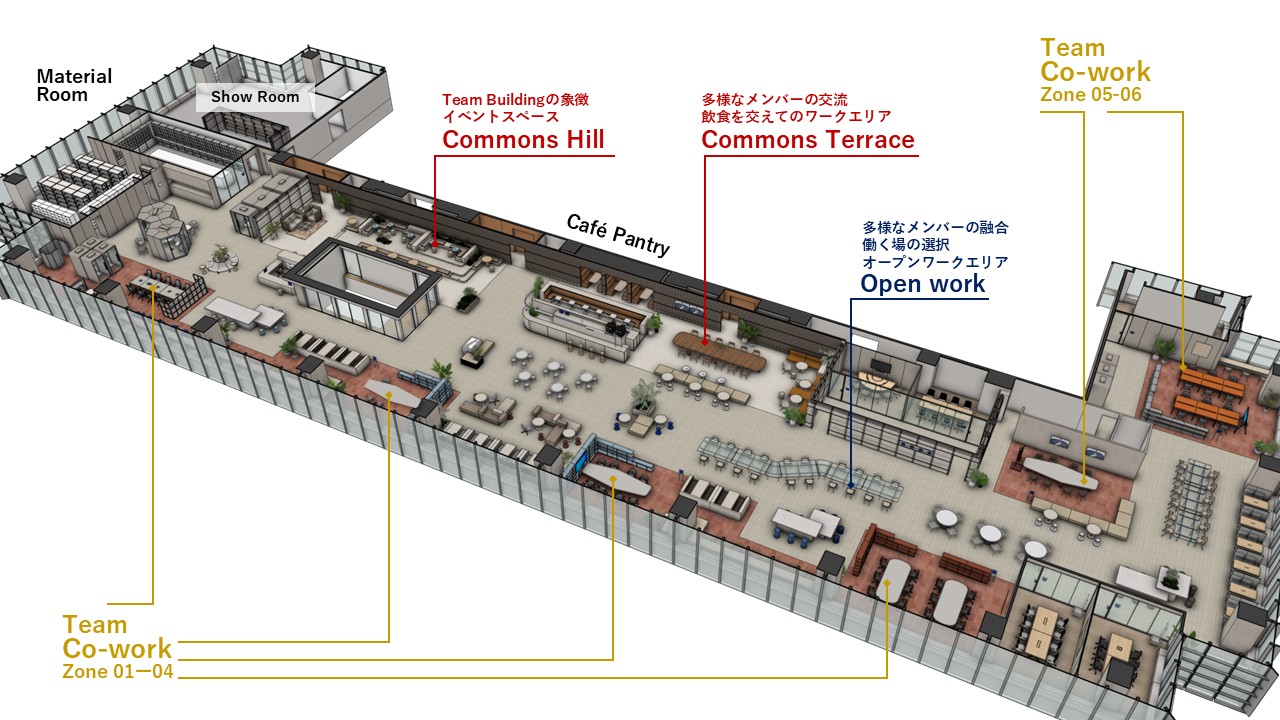
Overhead view of the renovated 12th floor
Based on these analysis results, we revised the layout, which previously emphasized solo work. We restructured the space to foster team growth and results, building upon the individual autonomy and self-determination of work styles cultivated through ABW (Activity-Based Working).
The floor features six "Team Co-work Zones" designed for easy teamwork. Each zone can accommodate 6 to 16 seats and can be reserved on a zone-by-zone basis. In addition to large tables, there are also counter seats and sofa seats, allowing team members to choose their workspace depending on the situation, whether for individual work or discussion.
Furthermore, the number of seats after the renovation has increased from 275 in the previous plan to 304. The total number of seats has increased by approximately 110%, and the space has been reallocated within the limited area to accommodate solo work, team co-working, interaction with food and drinks, and event use.
An "Open Work Area" has been created along the central circulation route, offering clear visibility and easy movement of people. This makes it easier to switch between solo work and team co-working, and encourages the integration of different teams and diverse members.
Furthermore, condition data revealed a need for places where people can easily eat, drink, and take breaks. Therefore, we placed "Commons Terrace" near the entrance and stairs to create a natural environment for interaction through cafes and relaxation. The space where people can eat and drink has been expanded from 18 seats to 86 seats, an increase of approximately 4.4 times.
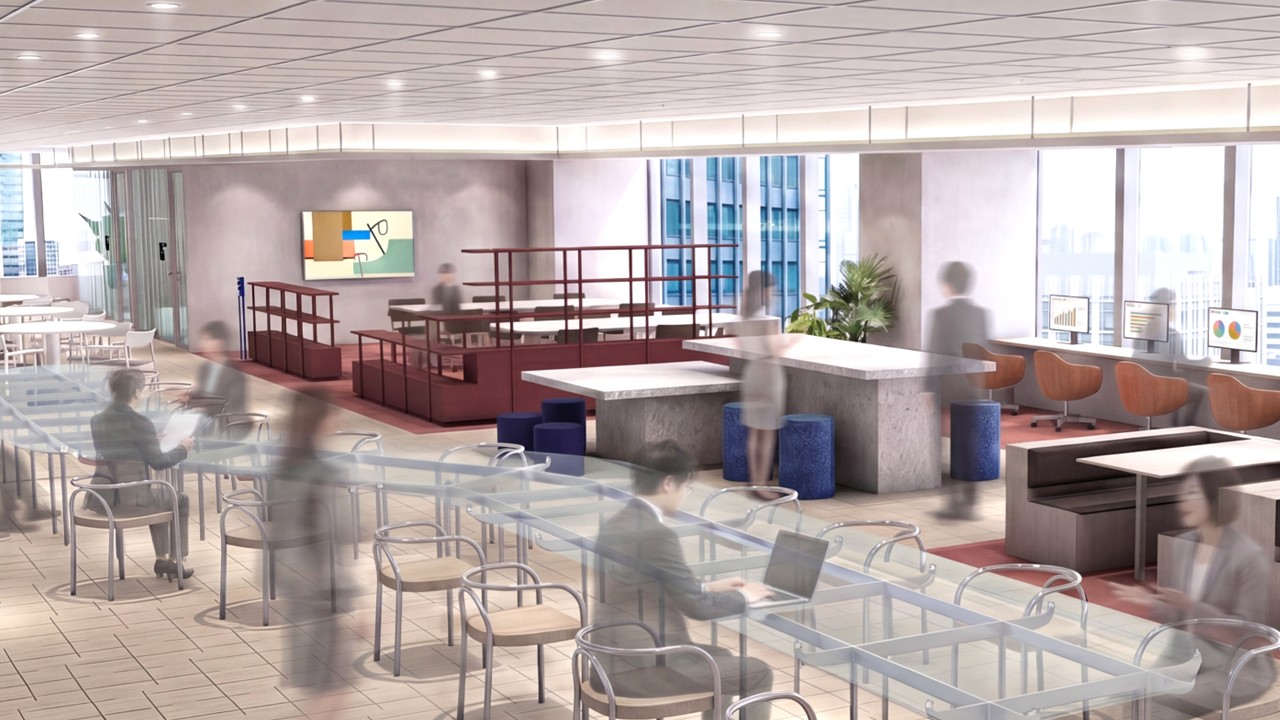
Team Co-work Zone/Open Work Area
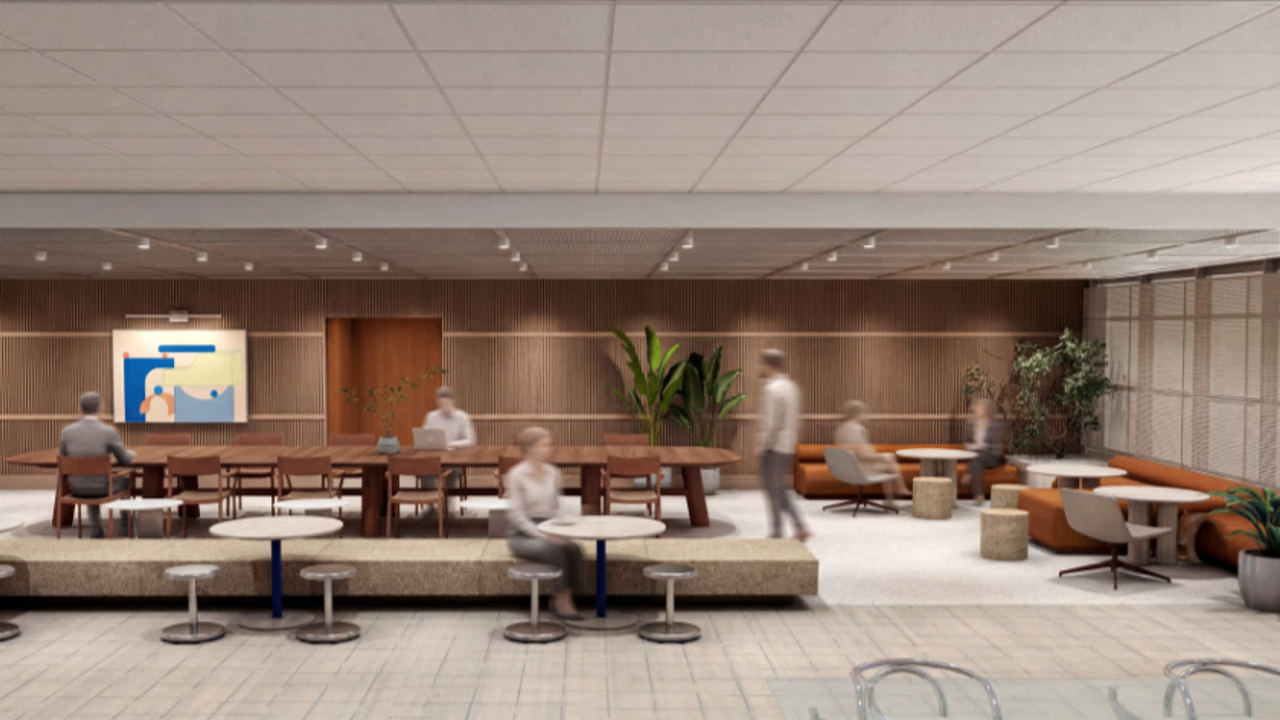
Commons Terrace: Fostering natural interaction through refreshing experiences.
From Nihonbashi, to a design where people, information, and ideas flow.
The new design for the 12th floor also reflects the historical significance of the Nihonbashi location. Nihonbashi is a town of commerce and culture that has continued since the Edo period, and it is a hub where people, goods, and information intersect.
Building on that context, the 12th floor was designed as a space where people, information, and ideas are loosely connected, creating a new flow within the organization. Like a river, people flow, encounters overlap, and transform into organizational strength. This expresses the unique "flow" of Nihonbashi as a modern office design.
A distinctive feature is that the team gathering space is constructed using furniture rather than fixed fixtures. By building the team co-working area with furniture, it becomes easier to adapt to future organizational changes and shifts in work styles.
Visualize results with data and optimize operations with AI.
In terms of operations, we have newly installed a prototype of "ITOKI OFFICE DEVICES," a device solution that fully implements AI in office operations. Sensor devices, including chair-specific and box-type sensors, visualize waste and inconvenience in office use by detecting absences in meeting rooms and reserved seats, displaying usage status, automatically releasing reservations, and understanding the actual number of users. This makes it easier for users to find available spaces and spaces that suit their needs.
Going forward, we plan to integrate this with "ITOKI OFFICE AI AGENTS," which was announced in February 2026, to develop a system that instantly suggests the optimal location based on the schedules, number of people, and usage patterns of employees.
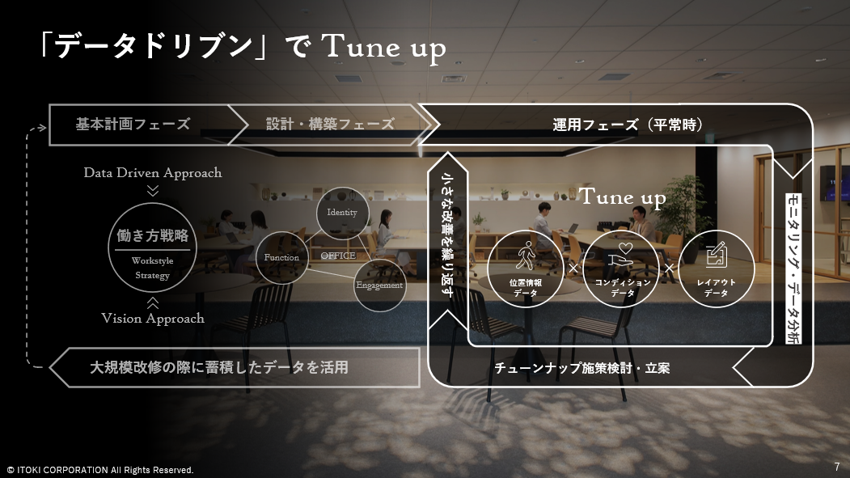
The office will be tuned up with a data-driven approach.
We view our office not as a space that is "built and then forgotten," but as a management foundation that is continuously updated on a high-cycle basis. Operational data not only visualizes how the space is used, but also changes the very starting point of the design process.
In this renovation, we have integrated data and design to implement, for the first time on a large scale, a workplace that contributes to maximizing human capital and organizational results. Moving forward, we will continue to monitor and analyze various office data and propose office designs that improve productivity and contribute to results, even in limited spaces, through our "tune-up consulting" service, which supports everything from identifying issues to design and operational improvements.
*The "pt" in various data is a score calculated by aggregating multiple questions and factors related to performance, and is therefore displayed as points. *Collected personal information will be encrypted and stored for security management purposes. Furthermore, during analysis, all data will be converted to a different pseudonym ID, and the data will be handled in a way that prevents the identification of individuals.
Equipment outline
| name | ITOKI DESIGN HOUSE TOKYO |
|---|---|
| Location | Nihonbashi Takashimaya Mitsui Building, 2-5-1 Nihonbashi, Chuo-ku, Tokyo |
| Applications | working showroom |
| Occupancy Floor | 11th to 13th floors |
| Renovated floor | 12th floor |
| Total area | Approximately 7200㎡ |
| Renovation area | Approximately 2700㎡ |
| Total number of seats | 934 seats |
| Renovation floor seating capacity | 304 seats |
| design | Sachiko Kayama, Rie Nishioka, Akari Hosoda, Midori Tanaka, Shinya Nakamura, Rintaro Miyaori |
| Tour reservation start date | Friday, June 12, 2026 |
| Contact information for tour applications | Itoki Official Website Showroom Page |
| Target audience | Business |
Related Information
ITOKI develops "ITOKI OFFICE DEVICES," which optimizes office operations through collaboration with AI agents.
https://www.itoki.jp/company/news/2026/0611_devices.html
ITOKI announces three AI agent groups, "ITOKI OFFICE AI AGENTS," marking a shift to the industry's first "AI management model."
https://www.itoki.jp/company/news/2026/0220_ai/
・ITOKI
DESIGN
HOUSE
https://idh.itoki.jp/
• Office data analysis service "Data Trekking"
https://www.itoki.jp/special/data-trekking/index.html
About Itoki's Workplace Business
ITOKI CORPORATION was founded in 1890. With the mission statement of "We Design Tomorrow. We Design WORK-Style. the company supports the creation of a variety of spaces, environments, and places, leveraging its strengths in "AI x Design based on people," including the manufacture and sale of office furniture, office space design, “Space," “Environment," and “Place" consulting, and office data analysis services, as well as furniture for working from home and studying at home, and equipment for public facilities and logistics facilities.
As hybrid work becomes more common and places and ways of working become more diverse, we are developing spatial digital transformation to enhance productivity and creativity, as well as consulting services to support optimal office operations. We are also proactively collaborating with external designers and partner companies to propose new work styles and workplaces for the future.
Press personnel
Contact information
ITOKI CORPORATION
Corporate Communications Division, Public Relations
TEL:03-6910-3910
- The information posted is current at the time of publication. Please note that the information may differ from the latest information.
*The "pt" in various data is a score calculated by aggregating multiple questions and factors related to performance, and is therefore displayed as points. *Collected personal information will be encrypted and stored for security management purposes. Furthermore, during analysis, all data will be converted to a different pseudonym ID, and the data will be handled in a way that prevents the identification of individuals.