
News room



[Survey on Elementary School Learning Trends] More than 40% of families whose children were accepted into their first-choice school had set up a dedicated desk for their child by the end of first grade
A survey was conducted among 1,023 parents of junior high school students (grades 1-2) across Japan regarding "home learning, junior high school entrance exams, educational investment, and learning environment."
ITOKI CORPORATION (Headquarters: Chuo-ku, Tokyo; President and CEO: Koji Minato) conducted the "Elementary School Student Learning Trends Survey" targeting 1,023 parents of junior high school students in grades 1-2 nationwide to understand the actual state of learning environments and study habits at home.
This survey analyzes differences in study time and educational investment based on whether or not a child has experience with junior high school entrance exams, as well as the relationship between study desk usage trends, study locations conducive to concentration, and desk and chair usage in early childhood, observed in families where children were accepted into their first-choice school. The results visualize "the reality of today's elementary school families," providing valuable insights for creating an environment that supports children's learning.
Special page URL: https://shop.itoki.jp/shop/pages/2-9studydesk.aspx
The Reality of Learning in Families Preparing for Middle School Entrance Exams vs. Regular Families: A Look at the Numbers
What differences can be observed in daily study time and investment in education between families who have experienced junior high school entrance exams and those who have not? In this survey, we obtained responses regarding home study time, study time at cram schools, use of cram schools, and amount of investment in education for sixth graders. Here, we summarize the current state of learning in elementary school families using numbers, focusing on the most frequently selected answers for each question.
*This survey uses the "most frequent response" rather than the "average value."
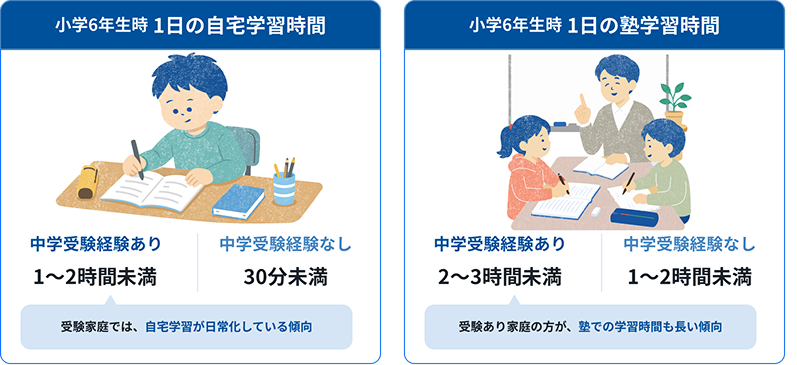
Among families with experience in junior high school entrance exams, the most common response for daily study time at home was “1 to less than 2 hours,” and for study time at cram schools, it was “2 to less than 3 hours.”In contrast, among families without experience with junior high school entrance exams, the most common responses for daily study time at home were “less than 30 minutes,” and for study time at cram schools, “1 to less than 2 hours.” This suggests that families with experience in junior high school entrance exams appear to set aside a certain amount of study time at home in addition to their study at cram schools.
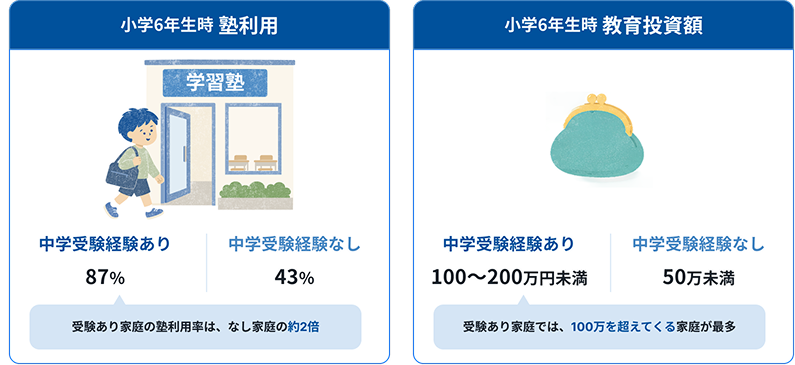
Furthermore, the percentage of sixth-graders attending cram schools was 87% among families whose children had taken junior high school entrance exams and 43% among families whose children had not; the rate of cram school attendance among families with experience in entrance exams was more than double that of families without such experience.Furthermore, regarding the amount invested in education, the most common response among families with experience in junior high school entrance exams was “1 million to less than 2 million yen,” while for families without such experience, it was “less than 500,000 yen.”
Research highlights
Families with children who have an academic achievement score of 60 or higher invest not only in tutoring but also in "improving the home learning environment" and "educational materials."
• The most popular study location for children with high concentration levels is their own room.
The most important factor for families where children were able to concentrate on studying was "storage that is easy to organize."
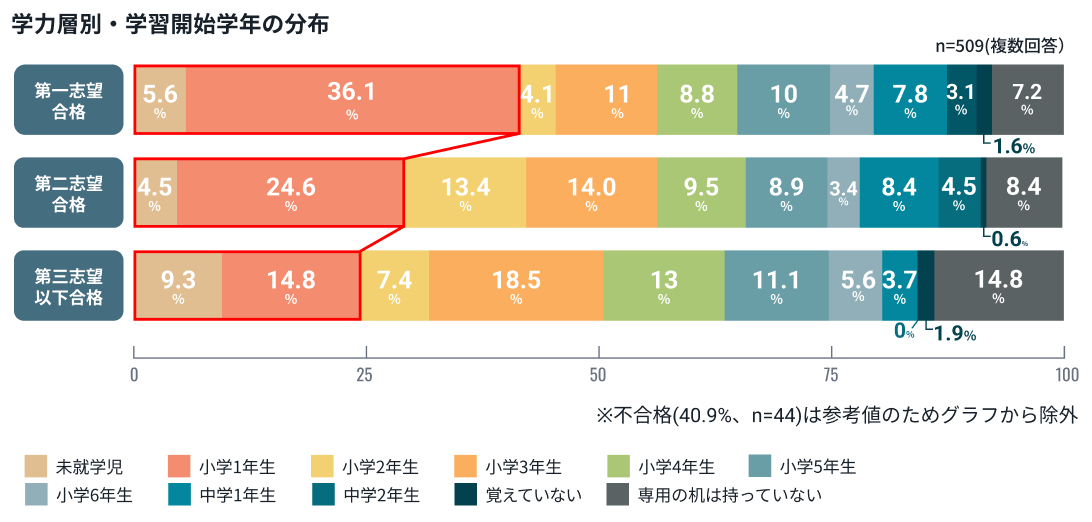
- Over 40% of families whose children were accepted into their first-choice school used their own desk by the time their child was in first grade of elementary school.
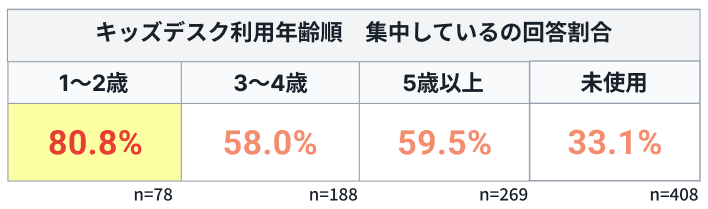
In families where children used a kids' desk from the age of 1-2, more than 80% were still focused on home learning by the time their children reached the 6th grade of elementary school.
Families with children who have a standard score of 60 or higher invest not only in cram schools but also in “creating a conducive home environment” and “study materials.”
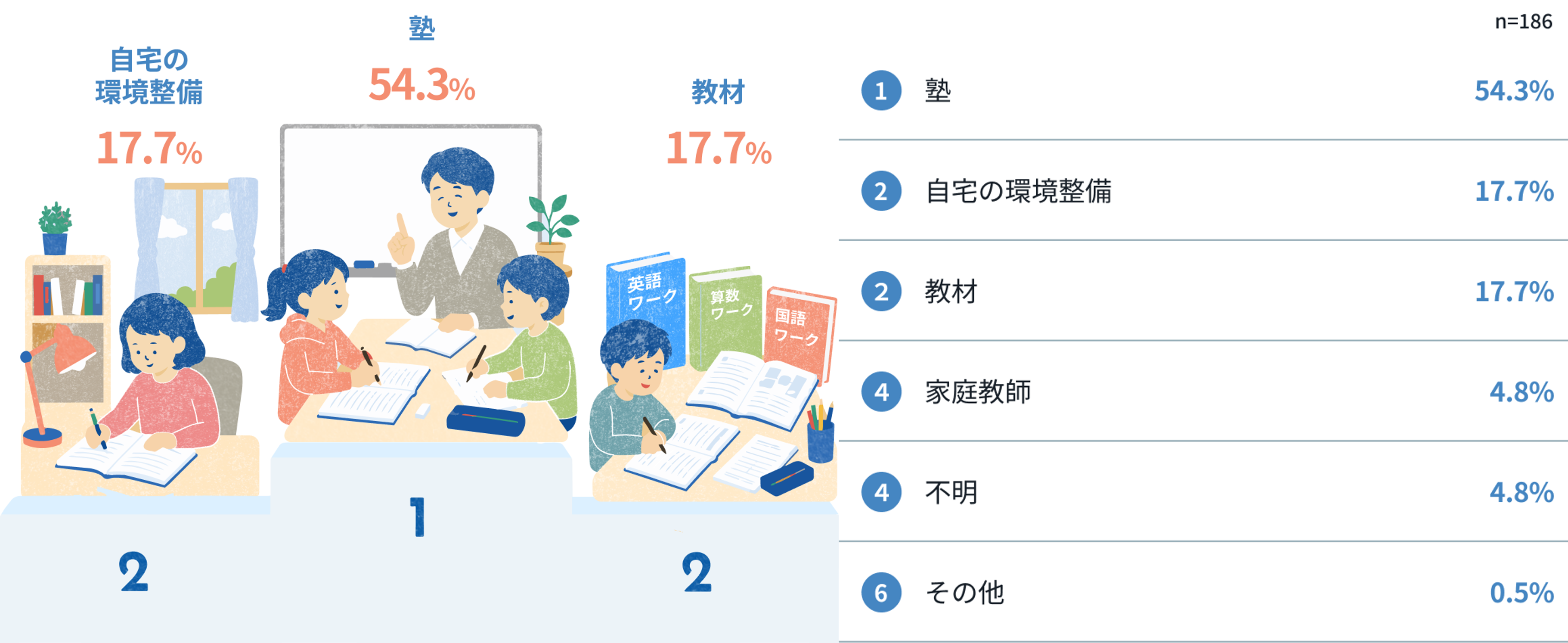
When families with children who score 60 or higher on the standardized test were asked about the largest proportion of their investment in improving their child's academic performance during elementary school, "cram school" was the most common answer, followed by "improving the home environment" and "educational materials," both tied for second place.
While many families prioritize cram schools during the junior high school entrance exam period, families with children who achieve a standard score of 60 or higher tend to also invest in creating a conducive learning environment at home and in providing learning materials.
"Children's Rooms" Rank High as Study Spaces for Children with Strong Concentration
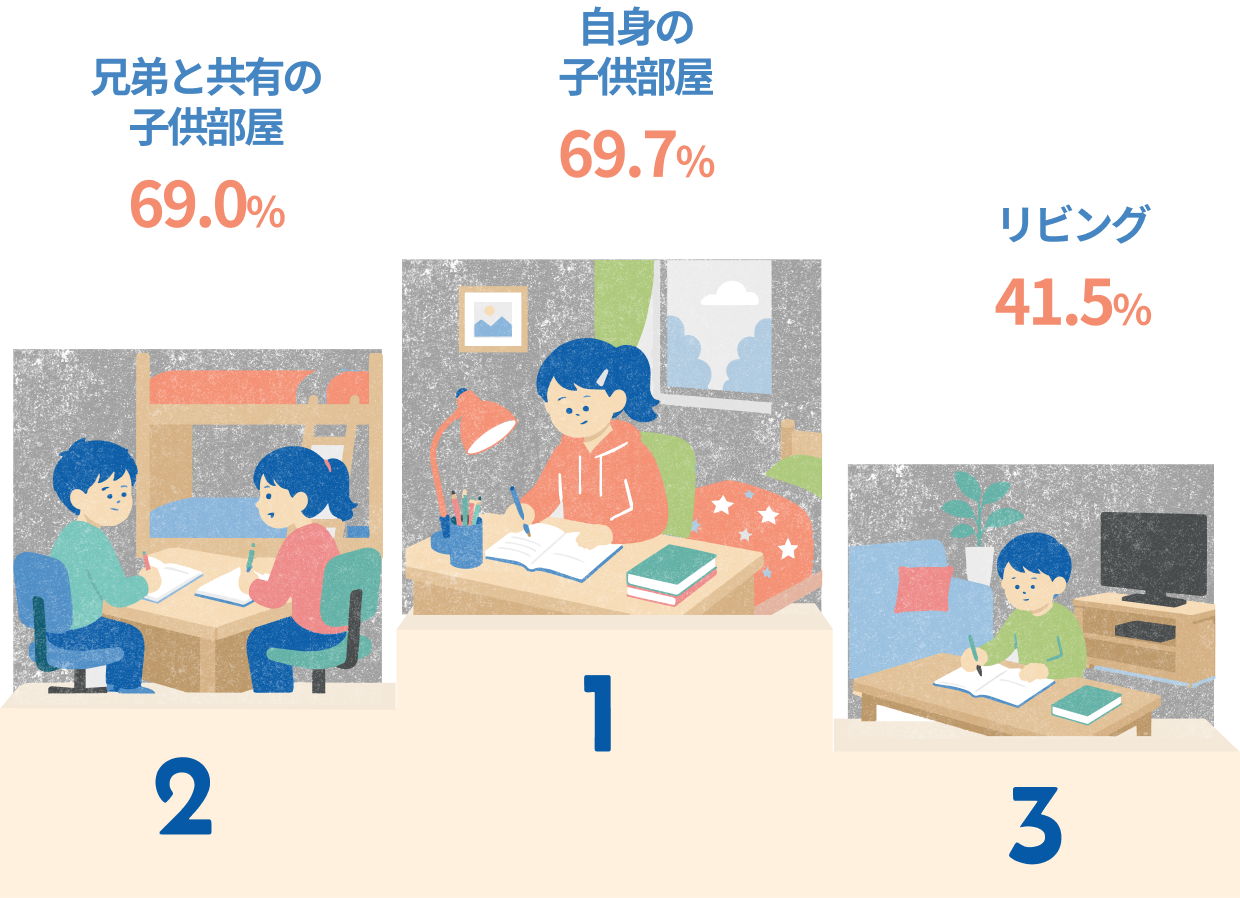
Looking at the study locations at home for children who were concentrating on home learning in the 6th grade of elementary school, "their own child's room" was the most common at 69.7%, followed by "a child's room shared with siblings" at 69.0%. On the other hand, "the living room" was at 41.5%, a lower result compared to the child's room.
While studying in the living room is often chosen as a place where parents can easily keep an eye on their children and help them develop good study habits, around the sixth grade of elementary school, children may be more likely to choose their own rooms, where they are less likely to be distracted by surrounding noise and people's movements, as a place where they can concentrate.
As students progress through the grades, it becomes increasingly important to create a home study environment that is not only easy to supervise but also conducive to concentration.
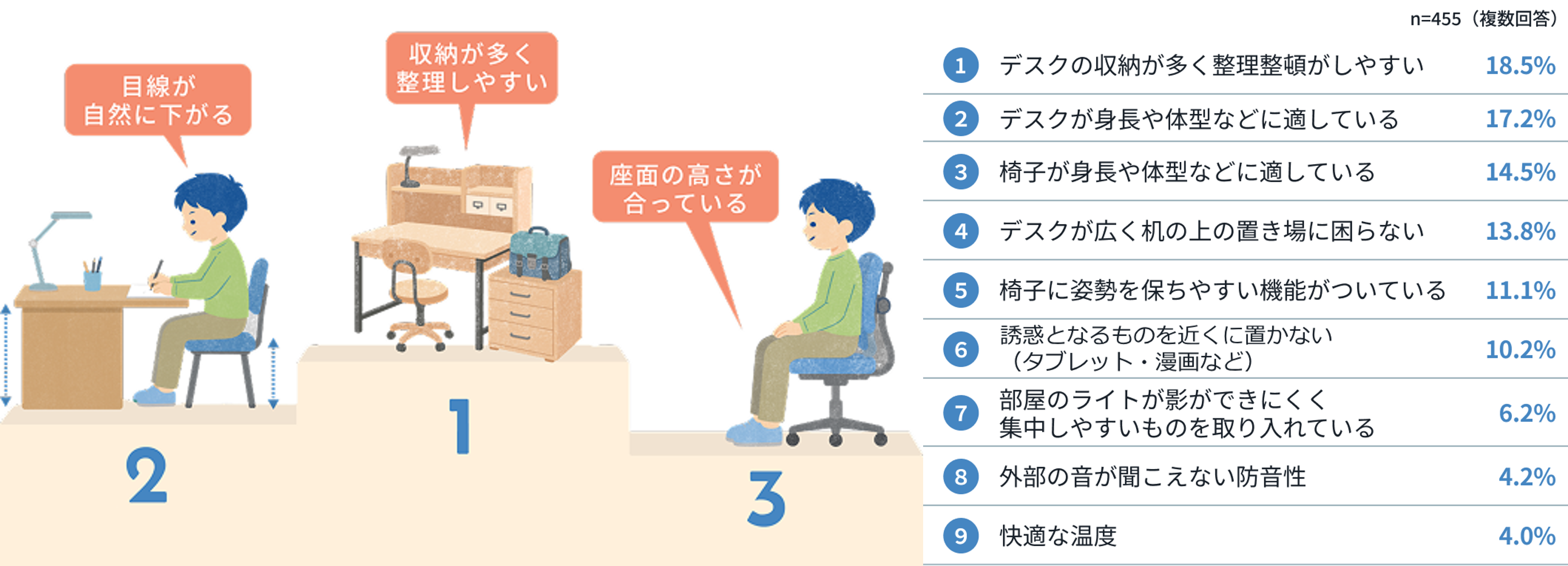
The learning environment prioritized by families who focused on studying: “Storage that makes it easy to keep things organized” ranked first.
When families whose children were focusing on home learning in the 6th grade of elementary school were asked what they considered important when creating a learning environment, the most common answer was "a desk with plenty of storage space that makes it easy to keep tidy," at 18.5%. This was followed by "a desk that is suitable for the child's height and build" at 17.2%, and "a chair that is suitable for the child's height and build" at 14.5%.
In households where children were able to concentrate on their studies, it was found that in addition to desks and chairs being suitable for the child's body, storage solutions that made it easy to organize textbooks and stationery were also important. It is thought that not only providing a new study desk, but also reviewing the storage around the desk and study space is one way to create an environment where children can concentrate on their studies.
More than 40 percent of families whose children were accepted to their first-choice school had their children using their own desks by the time they were in first grade.
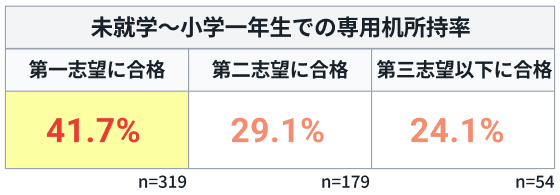
Looking at the timing of when students started using their own desks, categorized by the results of their junior high school entrance exams, 41.7% of families whose children passed their first-choice school introduced a dedicated desk between preschool and first grade.
Among families whose children passed their second-choice school, 29.1% passed their second-choice school, and among families whose children passed their third-choice school or lower, 24.1% passed their third-choice school or lower. Families whose children passed their first-choice school tended to have a relatively high rate of providing their children with their own dedicated study space by the time they were in the lower grades of elementary school.
Using their own desk from an early age can help establish a clear "study space" within the home, potentially leading to the development of a daily habit of sitting at their desk.
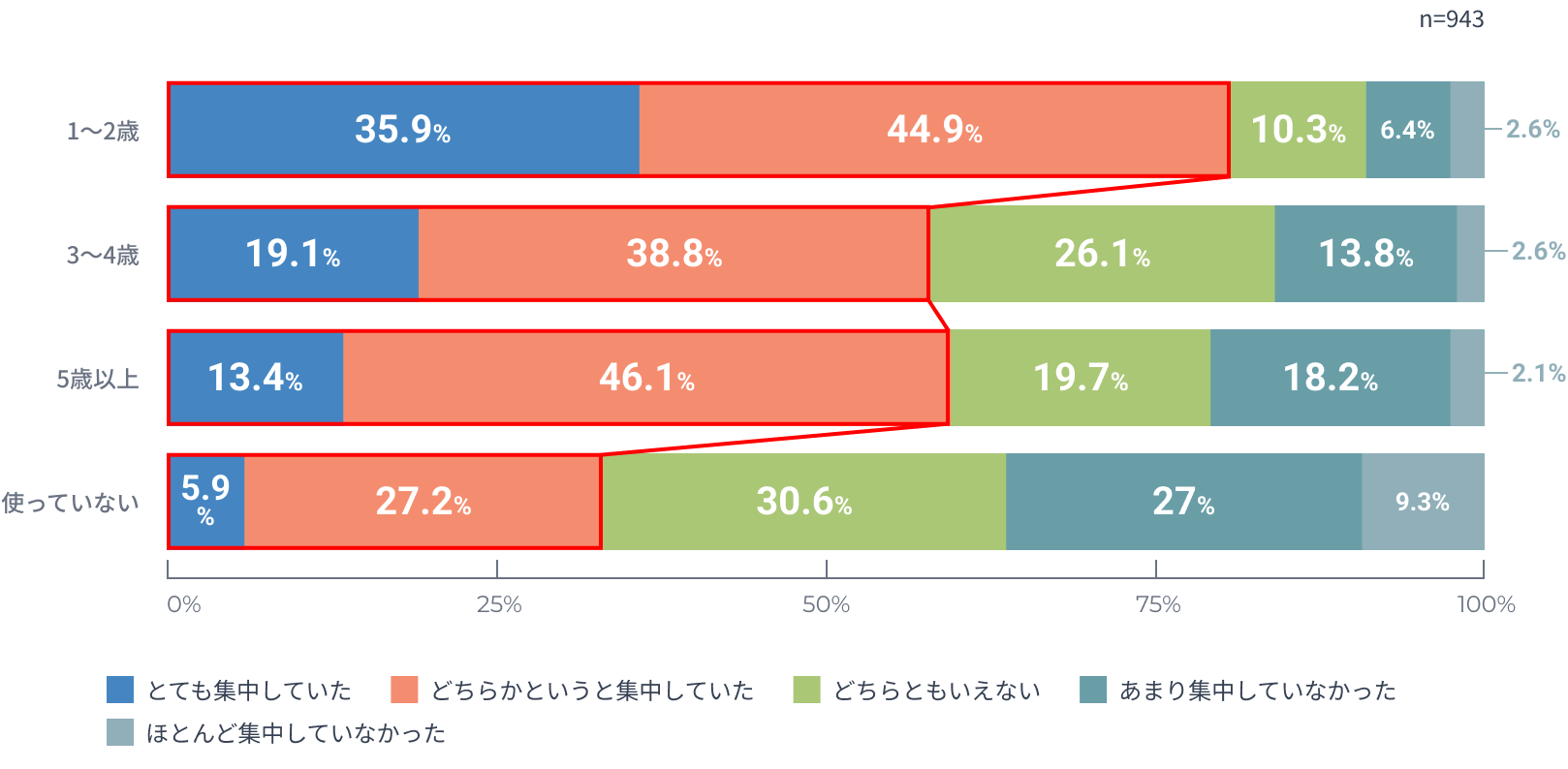
In households where children began using a kids' desk between the ages of 1 and 2, more than 80 percent were still able to concentrate on their homework at home by the time they reached sixth grade.
When examining the level of concentration during home study at the time of sixth grade, categorized by when kids' desks were first used, 80.8% of families who started using kids' desks from the age of 1-2 reported that their children were "concentrating." In contrast, 58.0% of families who started using them from the age of 3-4, 59.5% of families who started using them from the age of 5 or older, and 33.1% of families who did not use them.
In households where children had access to their own small desk and chair from the age of one or two, there was a higher tendency for them to concentrate on home learning even when they reached the sixth grade of elementary school.
It is possible that early childhood experiences of reading picture books or doing crafts in "their own space" contribute to later development, such as developing the habit of sitting at a desk and easily switching to studying.
Overall
Manabu Ishihara, General Manager, Web Business Division ITOKI CORPORATION

To help children develop lasting study habits, it is important to create an environment tailored to their stage of development
In recent years, there have been concerns in educational circles that “children are finding it harder to maintain their concentration.” Concentration depends not only on a child’s motivation but is also greatly influenced by the home environment—including where they study, their attitude toward learning, and whether their learning materials and supplies are readily available.
In this survey, households where sixth-graders were able to concentrate on their studies consistently ranked “children’s rooms” as the top study location, and there was a tendency to prioritize easy storage and desks and chairs that fit the child’s body.When supporting children’s learning, it is important not only to consider study time, tutoring, and learning materials, but also to create an environment that facilitates concentration in line with their stage of development. At Itoki, we have long been committed to developing products that support children’s learning, and we will continue to support their healthy learning and growth through product development that reflects our customers’ feedback.
Survey overview
| subject | Parents of first- and second-year middle school students nationwide |
|---|---|
| Investigation period | June 2026 |
| Research method | internet research |
| The number of samples | 1023 |
| subject | ITOKI CORPORATION |
Past Surveys
• Survey on trends in elementary school enrollment (Published February 3, 2026)
https://www.itoki.jp/company/news/2026/0203_research/
- Survey on the actual state of children's home learning environment (Published February 10, 2025)
https://www.itoki.jp/company/news/2025/_32027/
Hosting a “Chair Trial Event for Elementary and Middle School Students” Where Parents and Children Can Try Out Study Chairs Together
Based on the results of this survey, Itoki will be holding an event during the summer holidays where parents and children can experience the learning environment together.
At the event, we will be offering learning chairs and desks tailored to the growth of children, primarily those in upper elementary school and junior high school. You can try out the chairs and desks in person and discuss how to create the perfect learning environment for your child.
We also plan to hold workshops that parents and children can enjoy together. We hope to provide an opportunity for parents and children to think together about creating a better learning environment for the future during the summer holidays.
[Event Overview]
| Event name | Chair Trial Event for Elementary and Middle School Students |
|---|---|
| event date | Saturday, August 1, 2026; Saturday, August 22, 2026 |
| Venue | Itoki Tokyo Showroom “ZA SALON TOKYO” |
| subject | Children in elementary and middle school and their families |
| Content | Testing out study chairs and desks, consultations on study environments, and workshops for parents and children |
| Shipping | Vertebra, Torte U, Note, Creta, and others |
| Registration URL | https://www.itoki.jp/consumer/showroom/zasalon_child_trial/ |
About Itoki's Learning Environment Business
ITOKI CORPORATION was founded in 1890. With the mission statement We Design Tomorrow. We Design WORK-Style." the company manufactures and sells office furniture, designs office spaces, provides work style consulting and office data analysis services, and also supports the creation of various “Space," “Environment," and “Place" by leveraging its strength in "AI x Design based on people."
In our learning environment business, we have been focusing on children's learning environments for over 60 years, ever since launching Japan's first steel study desk for home use in 1962. From study desks to chairs that support correct posture as children grow, and storage furniture that fosters organizational skills, we are constantly working to create products that meet the needs of the times. Moving forward, we will continue to work to create environments that support the healthy growth of children and nurture a better future for learning.
To this release
Contact information
ITOKI CORPORATION
Home Furniture Contact Us
Please contact us using the inquiry form below and write “Regarding the Learning Trends Survey” in the message field.
Press personnel
Contact information
株式会社イトーキ
コーポレートコミュニケーション本部
広報課
TEL:03-6910-3910
- The information posted is current at the time of publication. Please note that the information may differ from the latest information.