
News room



[Survey on trends in elementary school admissions] First graders spend more than an hour a day on smartphones and tablets, and digital issues are also high on the list of parents' concerns.
Survey of 1,100 parents nationwide with first-grade elementary school children (enrolling in 2025) about "lifestyle, learning, play, and digital utilization after enrollment"
ITOKI CORPORATION (Head office: Chuo-ku, Tokyo; President and CEO: Koji Minato) conducted an "Elementary School Entrance Trend Survey" targeting 1,100 parents nationwide with first-grade children (enrolling in 2025) to understand the actual situation of households before and after enrollment, including "lifestyle habits after enrollment," "home learning," "playing style and play areas," "digital contact," "extracurricular activities and costs," and "pocket money."
In this survey, in addition to examining how the "place" for home learning relates to study time and digital utilization, we also analyzed differences based on gender, birth order, parental age, etc. We visualized the "realities of today's first-grade families" that will be useful for preparing for school entrance and planning daily life.
Special page URL: https://shop.itoki.jp/shop/pages/2-9studydesk.aspx
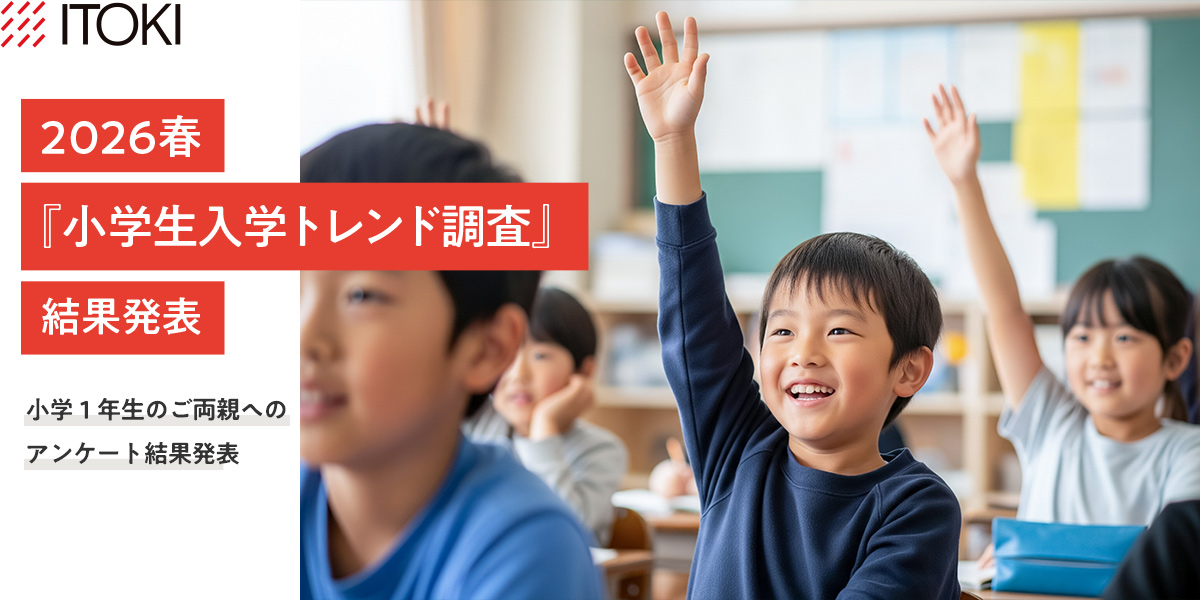
The reality of today's families with first graders in elementary school, as seen in numbers
What changes are occurring in the daily rhythms, learning, and play patterns of families with first-graders now entering elementary school? This survey asked about wake-up and bedtime times, home study, digital use, frequency of play, and more. Here, we've compiled a number of figures that show the typical daily routines seen in families with first-graders today, focusing on the most frequently selected answers for each question.
*The time spent using digital devices in this survey was limited to use at home, excluding time spent at school.
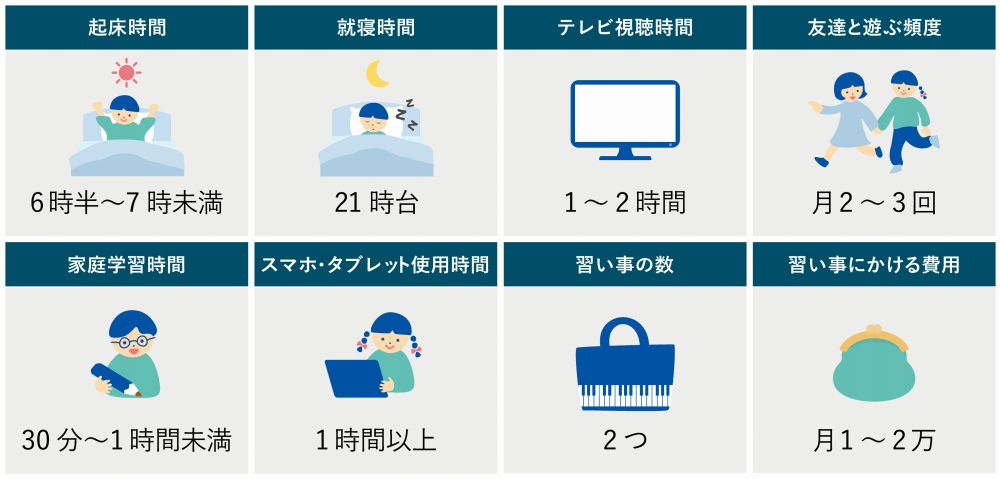
*In this survey, the most frequently answered "most popular answer" is listed, not the "average value."
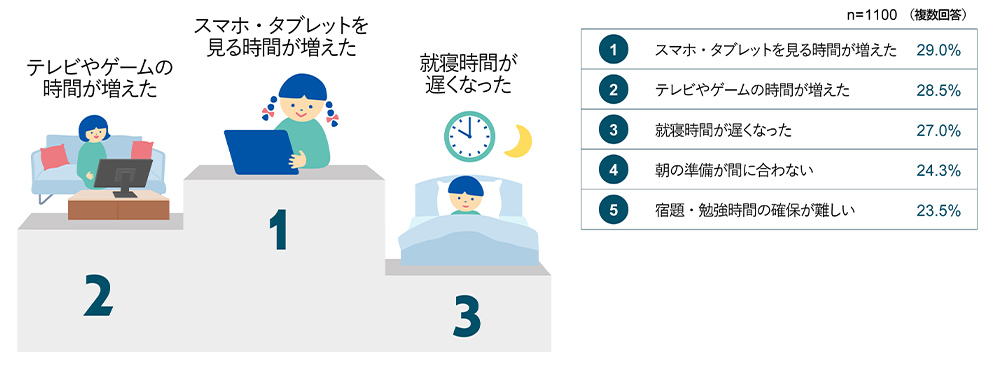
Ranking of problems parents face after their children enter school
When asked about problems they are facing in their lives since entering school, the most common answer was "more time spent looking at smartphones/tablets" (29.0%), followed by "more time watching TV/games" (28.5%) and "later bedtimes" (27.0%), suggesting that many families are struggling with digital contact and time management.
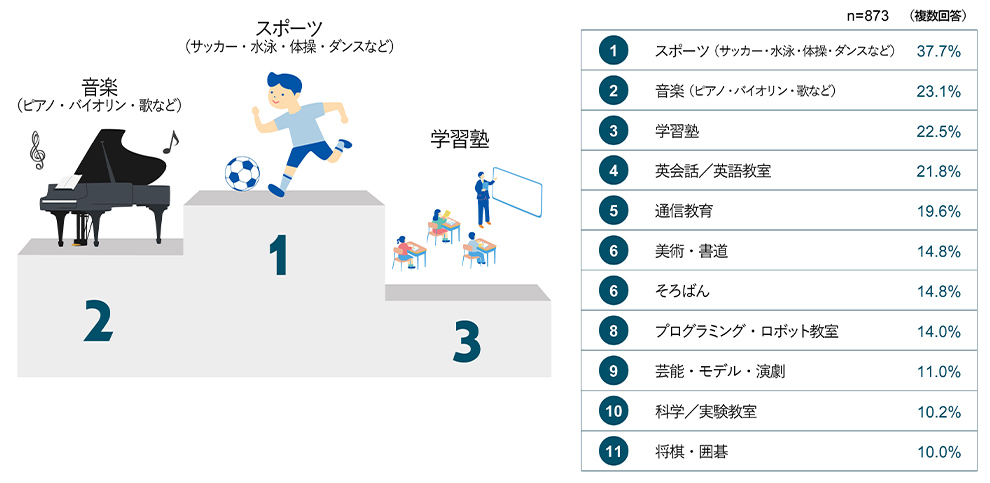
Lesson ranking
When asked about the type of extracurricular activities they are currently taking, the most common answer was "sports (soccer, swimming, gymnastics, dance, etc.)" at 37.7%, followed by "music (piano, violin, singing, etc.)" at 23.1%.
"Cram school" (22.5%) and "English conversation/English classes" (21.8%) follow closely behind.
While physical activities are the most common, language and learning-related activities also rank highly, suggesting that children are choosing activities with the aim of balancing exercise and learning, even as early as the first grade of elementary school.
Ranking of the most important purchases before entering university
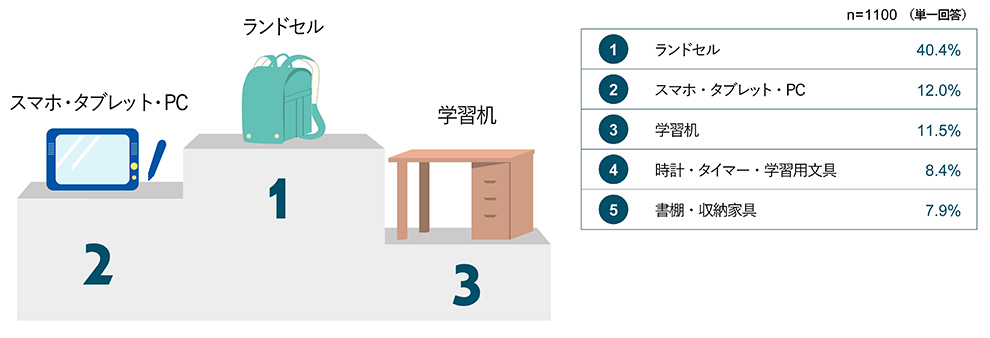
When asked about the "most important purchase" in preparation for school entrance, the top answer was "school bag" (40.4%), followed by "smartphone, tablet, PC" (12.0%). Following that, in third place was "study desk" (11.5%). This suggests that after essential items, there are a certain number of families who are conscious of making choices that create a good learning environment.
Research highlights
- In families using study desks, first graders spend more time studying at home – about 46% spend more than an hour studying at home
- In first grade, outdoor and digital play coexist, but the ratio is different for girls who play outdoors and boys who play digitally.
- Families with younger parents tend to spend more time studying at home and make greater use of digital learning
- Are middle children more likely to receive higher allowances? Birth order makes a difference in pocket money
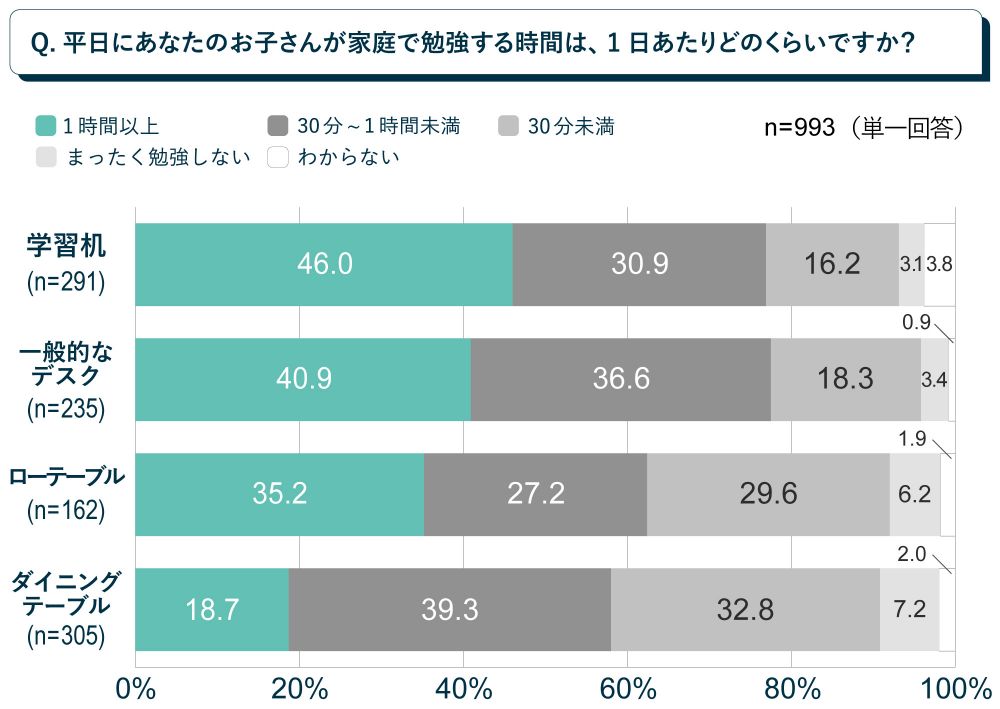
In households with study desks, first graders spend more time studying at home – about 46% spend more than an hour studying at home.
Looking at study time at home, in households that use a study desk, the percentage of those who study for "more than one hour" on weekdays was 46.0%, far exceeding the percentage of those who use the dining table (18.7%). Also, there is a tendency for the more "dedicated study space" a household has, including regular desks and low tables, the longer the study time.
For first graders who have just started school, the ability to "switch between tasks independently" is still in the process of being developed, and it is thought that the ease with which students know where to study helps them develop daily study habits.
In first grade, outdoor and digital play coexist, but the ratio is different for girls who play outdoors and boys who play digitally.
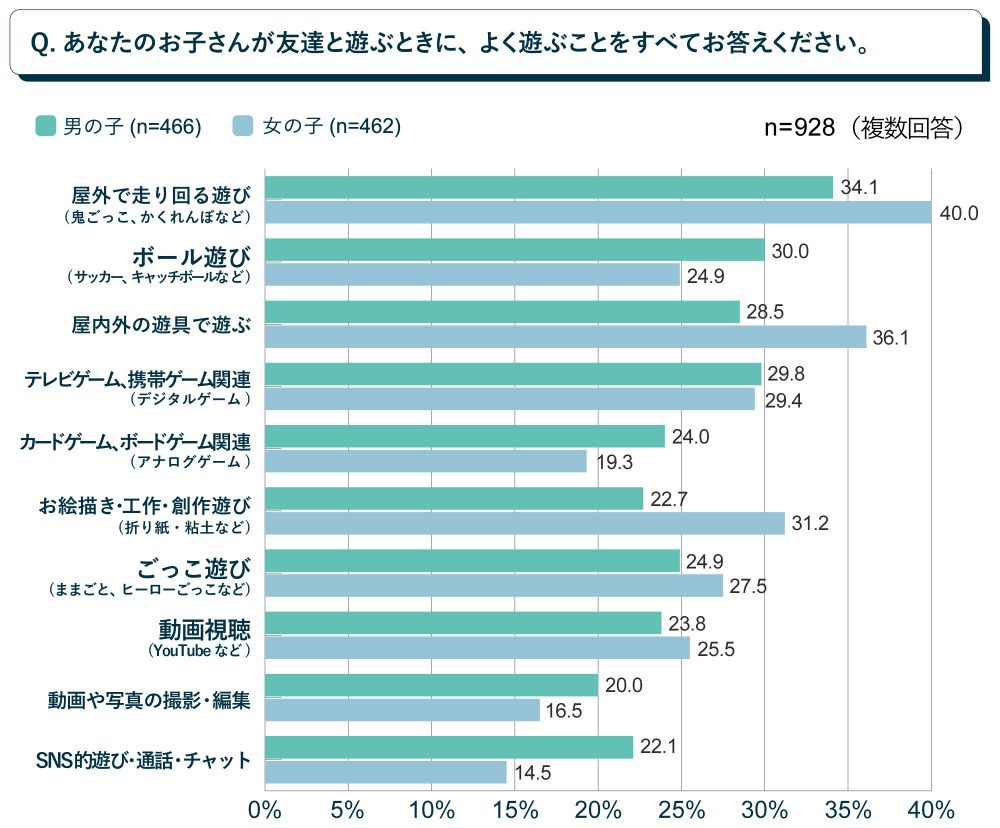
When looking at the types of play they do with friends, the percentage of girls who play games that involve running around outdoors (tag, hide-and-seek, etc.) is higher than boys, at 40.0% compared to 34.1%. Girls also tend to play on indoor and outdoor play equipment, at 36.1% compared to 28.5% for boys. Meanwhile, boys tend to play digital games, watch videos, make calls, and chat.
Families with younger parents tend to spend more time studying at home and make greater use of digital learning
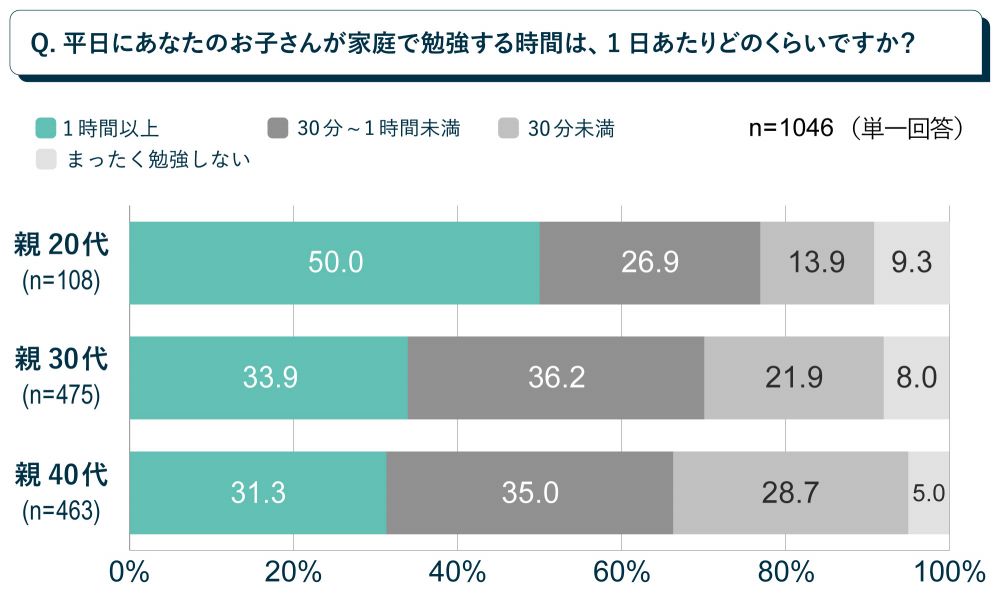
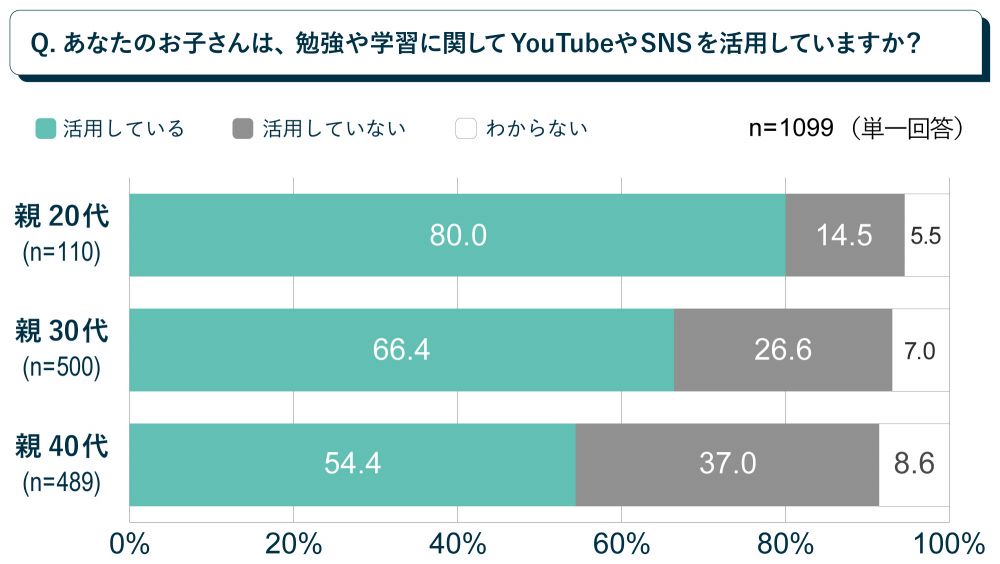
Looking at home study situations by parent age, 50.0% of households with parents in their 20s spend "more than one hour" studying at home on weekdays, a higher level than those in their 30s (33.9%) and 40s (31.3%).
Additionally, when looking at the use of YouTube and social media for studying and learning, approximately 80% of households where parents are in their 20s responded that they "use" them, a higher result than those in their 30s and 40s.
It appears that videos and online content are being naturally incorporated into home learning.
These results suggest that the younger generation of parents may be able to secure time for home study by incorporating a variety of learning methods, including digital methods, in addition to paper drills and studying at a desk.
It seems that differences in learning styles, not just the length of study time itself, but also the means by which children learn, are beginning to emerge between parent generations.
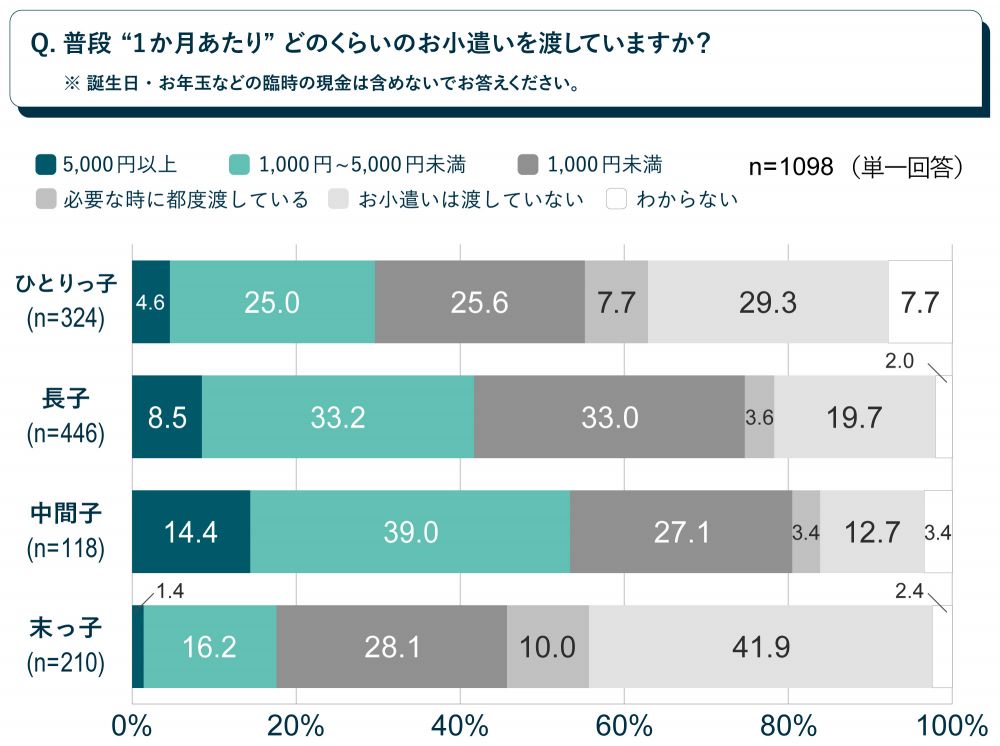
Are middle children more likely to receive higher allowances? Birth order makes a difference in pocket money
When looking at the amount of allowance given per month, the middle child had the highest percentage of people who answered "5,000 yen or more." On the other hand, the youngest child tended to receive "no allowance" or "small amount."
The difference in the amount of allowance based on birth order may be influenced by factors such as awareness of roles within the family and judgments based on comparisons with older siblings. This suggests that pocket money is designed by each family as an opportunity to learn how to manage money, rather than the amount itself.
Summary
Manabu Ishihara, General Manager, Web Business Division ITOKI CORPORATION

This survey revealed that in the homes of first-grade elementary school students, major themes include not only study time itself, but also how to regulate daily rhythms and how to interact with digital devices in play and learning.
What was particularly striking was that, while families with a clearly designated "study space" such as a desk tend to spend more time studying at home, there is also an increasing number of families that are flexibly incorporating digital learning content such as YouTube and social media.
I feel that home learning is not something that can be completed by simply spending time at a desk, but is beginning to be designed in a way that is unique to each family, combining the place and method of learning.
In terms of play, it also became clear that real-world playgrounds and online play coexist, and options are beginning to diverge depending on gender and family environment.
The first year of elementary school is an important time when the foundations for life, learning, and play are formed. Itoki will continue to support home learning environments and develop products from the perspective of creating spaces, so that children can naturally make learning a habit and their daily lives at home can be as organized as possible.
About Itoki's Learning Environment Business
ITOKI CORPORATION was founded in 1890. With the mission statement "We Design Tomorrow. We Design WORK-Style." the company supports the creation of a variety of spaces, environments, and places, leveraging its strengths in "Tech x Design based on people," including the manufacture and sale of office furniture, office space design, “Space," “Environment," and “Place" consulting, and office data analysis services, as well as furniture for working from home and studying at home, and equipment for public facilities and logistics facilities.
In our learning environment business, we have been focusing on children's "learning environments" for over 60 years since we launched Japan's first steel study desk for home use in 1962. We are constantly working to create products that meet the needs of the times, including study desks, chairs that support good posture as children grow, and storage furniture that fosters tidying skills. We will continue to support the healthy growth of children and work to create environments that foster a better learning future.
To this release
Contact information
Please contact us using the inquiry form below, writing "Regarding the elementary school enrollment trend survey" in the message field.
press personnel
Contact information
株式会社イトーキ
コーポレートコミュニケーション本部
広報課
TEL:03-6910-3910
- The information posted is current at the time of publication. Please note that the information may differ from the latest information.